

I bought the Bedsure PureWoven bamboo sheet set on a Tuesday in July, mostly because I was tired of peeling a damp pillowcase off the back of my neck at two in the morning. That is the whole origin story. Nobody recommended them to me. I had read enough labels to be suspicious of anything with the word bamboo on it, and I had already tried a set from a big box store that felt wonderful for three weeks and then went thin and pilly. I am 54, I live outside Harrisburg, and my night sweats started around 51 and still wake me a few nights a week. So I am not a sheet reviewer. I am a woman who would like to sleep through until five.
Here is what I expected: a marketing label, a slippery feel, and about a month of use before the fabric gave up. That is roughly what the last set did. Bedsure had a fair amount of skepticism to overcome with me, and I want to say up front that this is not a love letter. Four months in, these sheets are still on my bed, but there are three things about them I would want to know before I bought, and one of those is a genuine annoyance.
The Quick Verdict
Cool to the touch and noticeably better than cotton on a warm night, with real wrinkles and a routine you have to learn. Worth it for the hot side of the bed.
Amazon Check Today's Price →If your side of the bed runs hot, start here
Queen set, four pieces, over 25 colors, 16 inch pockets. If you want the short version before the long one, this is the set I kept.
Amazon Check Today's Price on Amazon →First, the Label Thing Nobody Explains
Almost nothing sold as bamboo sheets is actually woven bamboo fiber. The Bedsure packaging says it plainly: 100% rayon derived from bamboo. That is the standard process and it is not a trick, but it does explain why two sets labeled bamboo can feel completely different from each other. Rayon from bamboo is spun from dissolved bamboo cellulose, and what you end up with depends on how finely it is spun and how it is finished.
Why that matters for a hot sleeper: the fiber itself is not magic. What makes a sheet sleep cool is how much air moves through it, how much moisture it pulls off your skin, and how heavy the fabric sits on you. Bedsure lists breathable, cooling, moisture wicking, and soft and silky as the features, and the weight tells you something too. The entire queen set, fitted sheet, flat sheet, and two pillowcases, is 3.1 pounds. That is light. My old cotton set is heavier in the flat sheet alone.
The other thing on the label is OEKO-TEX Standard 100, listed as 24.HCN.19195. That means the fabric has been tested for harmful substances. I am not a chemist and I am not going to pretend I can verify a certificate number, but it is a real program, it is printed on the packaging, and a lot of sheet listings will not give you anything like it.
How I Actually Used Them
I did not set up a lab. I put these on a queen mattress in the upstairs bedroom of a 1960s brick two-story that runs warm from May through September. One window air conditioner, one ceiling fan, and a husband named Rick who sleeps cold and wants a blanket over his legs no matter what the thermometer says. If you are after a controlled study, this is not it. If you want to know how a set of sheets behaves in an ordinary hot bedroom, keep reading.
I measured the mattress before I ordered, the way you measure a window before you buy curtains. Queen mattress, two inch topper, tape measure pulled tight over the corner, about twelve inches at the deepest point. I had tried a cotton percale set back in June first. It slept crisp for about an hour and then went warm and stayed warm. I also tried one of those gel pillow pads that promises to stay cold. It was cold for twenty minutes and then it was just a pillow.
I washed them before the first use and I have washed them every week since. Cold water, low tumble, and I take them out of the dryer while they are still a little damp. I will explain why in a minute, because that is the part that nearly made me give up on them. I also rotate a second set, partly so I could compare and partly so I would not sleep on the same fabric every night for four months and stop noticing it.
What I paid attention to, without keeping a notebook: how the pillowcase felt at two in the morning during a flash, whether the fitted sheet stayed on the corners with a topper underneath, how the fabric felt on my shoulders when I woke up damp, and whether Rick complained. That last one is its own kind of data.
Nothing on a bed stops a hot flash. What these sheets did was make the ten minutes after one more bearable, and that turned out to be worth paying attention to.
The Cooling Part, Honestly
The honest version is this. These sheets feel cool when you get in. That is the silkiness of the rayon and it is not a small thing. If you are the sort of person who flips the pillow hunting for the cool side, this is a set that gives you that feeling across the whole bed instead of in one square foot of it.
What they do not do is stop a hot flash. Nothing on a bed stops a hot flash. I want to be plain about that, because I have bought things hoping otherwise and it is an expensive way to be disappointed. What these sheets did do is make the stretch after a flash more bearable. Rayon from bamboo moves moisture off your skin faster than my cotton percale did, and the fabric does not turn into a wet washcloth against your back. I would wake up damp and cool down, instead of waking up damp and staying clammy. There is a real difference between those two things.
One night in early August I actually looked at the clock. The upstairs thermometer read eighty-four degrees at ten at night and the window unit was losing. I woke at 1:40, damp across the shoulders, and I was back asleep by 2:05. On the old cotton set that same kind of night would have had me up until three, flipping the pillow and eventually going downstairs to the couch.
A word about the word cooling on the listing. It does not mean refrigerated and it does not mean you will never sweat. It means the fabric touches cool and it lets heat out. I still wake up sometimes. I just do not lie there stewing in it for half an hour the way I used to.
The other surprise was Rick's side. He sleeps cold, and I worried that a cooling sheet would make his half of the bed miserable. It did not. These are cool to the touch, not cold, and he never once asked for the flannel back. If yours is the split where one of you is kicking the covers off and the other is burrowing under them, this set handles that better than a heavy cotton sateen would.
Where I would set expectations: on a night when the upstairs is genuinely hot and the window unit cannot keep up, these sheets are not an air conditioner. They are better than what I had. They are not a fix for a hot room, and I would not buy them expecting one.
The Parts Nobody Warns You About
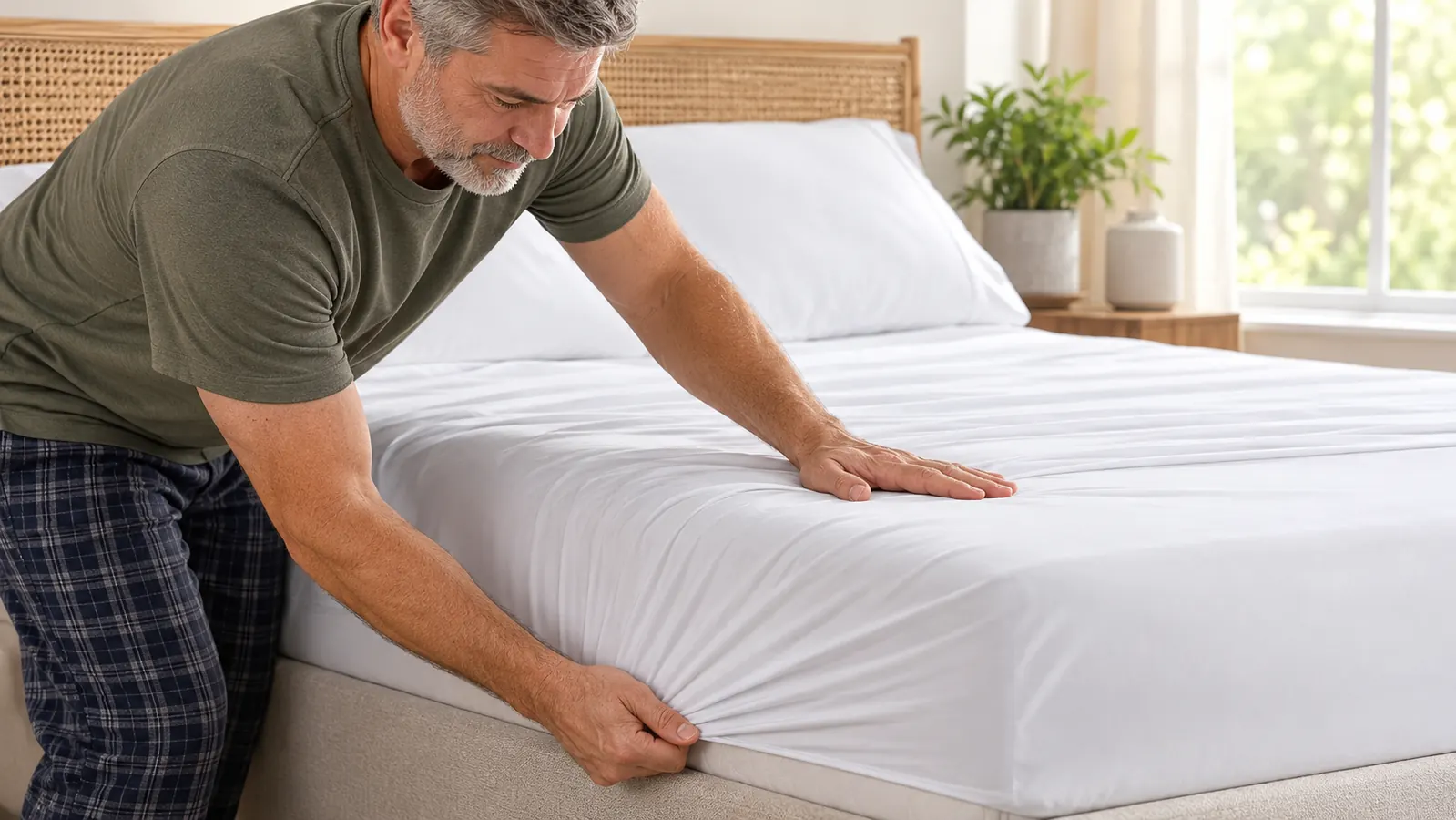
The wrinkles. I am starting here because it is the thing I most want you to know. Rayon from bamboo wrinkles. Not a little. If you pull these straight out of the dryer and put them on the bed, they look slept in before anyone has slept in them. The flat sheet is the worst offender because it drapes. I now take them out while damp and smooth them by hand across the bed, and that mostly handles it. If you need a crisp, hotel flat bed, this is not the fabric for that and no amount of smoothing will change it. Rick made the mistake of folding the flat sheet still warm from the dryer the first week and set a crease down the middle that I could not press out. I tried an iron on the lowest setting with a damp cloth over it, which helped for about an hour. Now I fold nothing until it is cool. That one change did more for how the bed looks than anything else I tried.
The drape. These sheets are silky, which means the flat sheet slides. It does not tuck under the mattress and stay tucked the way a stiff cotton sheet does. It also shifts around on you, and if you are a restless sleeper you will wake up with it half off. I got used to it. Rick did not, and he now sleeps with the flat sheet only up to his waist.
The pillowcase closure. Bedsure uses an envelope closure, which means the pillow tucks into a flap. It holds fine and there is no zipper to catch your face, which I appreciate at my age and with my sleep. It also means the pillowcase fits one way, and if you have a pillow that runs deep, the flap stretches and never quite lies flat. Small thing. You will notice it every night anyway.
The thinness. These are not sheer, but they are light. If you have a patterned mattress or a dark topper, you will catch a hint of it through the fitted sheet when the light is behind it. That is the tradeoff for a fabric that breathes this well. I would make it again, but it is worth knowing before you strip the bed and find out.

The Fit, Which Was Better Than I Expected
The fitted sheet is listed as a 16 inch deep pocket with a full 360 degree elastic band, and that is the number to check against your own mattress before you order. My queen with a two inch topper is well under 16 inches, and the sheet went on with room to spare. It has not popped off a corner once in four months. I am someone who used to fight with the fitted sheet at three in the morning on a regular basis, so that is not a small endorsement.
The set is four pieces: fitted sheet, flat sheet, and two pillowcases at 20 inches wide. Queen, per the listing. The pattern is solid, nothing printed on it, and Bedsure makes it in a long run of colors, over 25 according to the packaging. That is more choice than I needed. I picked one that would not advertise every crease, which, given the wrinkle situation, was the right call.
What Four Months of Weekly Washing Did
This is the part that settled it for me. My last set of bamboo sheets pilled along the fitted sheet where my hips and shoulders rub, and it started around week four. The Bedsure set has been through the wash once a week for four months and I can find exactly one small rough patch near the foot of the fitted sheet, where Rick's heels catch. One patch. The rest of the fabric is still smooth to the hand.
I bought the set in July. By the middle of November it had been through the machine somewhere around seventeen times, counting the two weeks I put the cotton set back on out of curiosity. I counted the washes off a calendar, not out of diligence, but because I wanted to be able to say a real number instead of a vague one. Seventeen washes, one rough patch, no thinning at the corners.
The elastic has held. The corners are still snug across that 360 degree band and I have not had to re-stretch it. The seams are intact, and the envelope flap on the pillowcases has not frayed at the fold, which is exactly where the last set went first.
The one warning I will give you: if you wash these warm and dry them hot, you will shorten their life. I know because I did it once by accident in the first month. They came out of the dryer noticeably tighter, with a crease set into the flat sheet that has never fully come out. Cold wash, low tumble, out while still damp. That is the whole routine and I would not skip it.
What I Liked
- Feels cool the moment you get in and stays cooler than my cotton percale through the night
- Moves dampness off your skin instead of holding it against your back
- 360 degree elastic and a 16 inch pocket held on a queen with a two inch topper, no popped corners in four months
- Light at 3.1 pounds for the whole four piece set, so it does not sit heavy on you
- OEKO-TEX Standard 100 tested for harmful substances
- Envelope pillowcase closure, nothing to catch your face in the dark
Where It Falls Short
- Wrinkles badly if you put them straight on the bed from the dryer
- The flat sheet slides and will not stay tucked the way cotton does
- Light enough that a patterned topper shows through under a lamp
- Needs a damp-dry and hand-smooth routine to look presentable
- Pillowcase flap stretches and will not lie flat on a deep pillow
- Not for a mattress over 16 inches thick
Who This Is For
If you are in the same stretch of life I am in, waking a few nights a week with your neck damp and your pillow warm, this set is worth trying. It will not stop the flash. It will make the minutes afterward less miserable, and at two in the morning that is most of what you are asking for.
It also suits a couple with a temperature split. If one of you sleeps hot and the other sleeps cold, a light moisture wicking sheet under a shared blanket is a reasonable compromise, and it is the first one we have found that neither of us complained about.
Who Should Skip It
If you love a crisp, heavy cotton sheet that snaps when you shake it out, skip these. You will fight the drape and you will hate the wrinkles, and no amount of cooling will make up for a bed that feels wrong to you.
Also skip them if your mattress is thicker than 16 inches, or if you are not willing to wash cold and pull them out of the dryer early. These sheets reward a small amount of fussing and punish a hot dryer. That is an honest trade, not a flaw exactly, but it is a trade.
And one more thing, because I would rather say it than not. If your night sweats have changed recently, gotten much worse, or come with other symptoms that worry you, that is a conversation for your doctor, not a bedding review. I am a retired school librarian. I can tell you about fabric. I cannot tell you about you.
Four months in, they are still on my bed
Queen, four pieces, 16 inch pockets, and a fabric that touches cool. If you are the hot side of the bed, this is the set I would hand you.
Amazon Check Today's Price on Amazon →