

It is usually somewhere around two in the morning when I give up and lie there doing arithmetic. I am 54, I live outside Harrisburg, and my night sweats have kept a standing appointment a few nights a week for about three years now. I would wake up with the sheets damp, my hair stuck to my neck, and my husband Rick peacefully asleep under an extra blanket, which did nothing at all for my mood. The first thing I blamed was the mattress.
Ours is a queen, twelve years old, gone soft in the middle, and I was convinced it was holding my body heat the way a brick wall holds the afternoon sun. So I tried the free fixes first. I kicked off the blankets. I slept in less. I aimed a fan at my face and woke up with a dry throat and the same damp sheets. Then I bought a Linenspa 2 Inch Gel Memory Foam Mattress Topper, partly because I wanted the bed to feel less like a hammock and partly because I figured a cooling gel could not possibly hurt. What I learned over the next few months is that a topper is one piece of a cool bed, not the whole thing. The Linenspa topper does what its listing says it does, which is capture and distribute heat. It cannot make the room colder, and it cannot outwork three blankets and a quilted mattress pad stacked on top of it. The five steps below are the whole setup, in the order I would do them again.
The layer closest to your skin does most of the work
A 2 inch plush gel memory foam topper goes on in minutes and changes how the bed feels from the first night. Everything else in this guide is easier once this part is right.
Amazon Check Today's Price on Amazon →Step 1: Find Out Where the Heat Is Actually Coming From
Before you buy anything, do a twenty-minute test on a warm afternoon. Lie on your side of the bed exactly as you would at night, no blanket, and set a timer. When it goes off, get up and put your palm flat where your shoulders and hips were. If that spot is noticeably warmer than the far corner of the mattress, the foam is holding you. If it feels about the same, the heat is coming from your bedding or your room, and no topper on earth will fix that on its own.
In my case it was both, which is the usual answer. The old mattress held heat, and I had a thick quilted mattress pad over it, which is essentially a second duvet under my back. I also had a polyester sheet set I loved the look of and that made me sweat within the hour. Once I started paying attention, I could feel the difference between a bed trapping my own body heat and a room that was simply too warm to sleep in. They feel different, and they need different fixes.
I ran that test twice, once in June at four in the afternoon with the fan going, and once in January with the heat on, and I got two different answers. In June the whole room was warm and the mattress was only a little warmer than the air around it. In January the room was cool and the mattress was clearly warmer than the far corner. Same bed, same foam, different problem each time. That is why I stopped treating this as one single thing to fix and started working through it in order.
Write down what you find. It sounds fussy, but it saves money. If your mattress sleeps warm and your bedroom sleeps warm, you have two problems and you have to work on both. If only the mattress is the problem, a topper alone will very likely be enough.
Step 2: Let the Linenspa Topper Expand Fully Before You Judge It
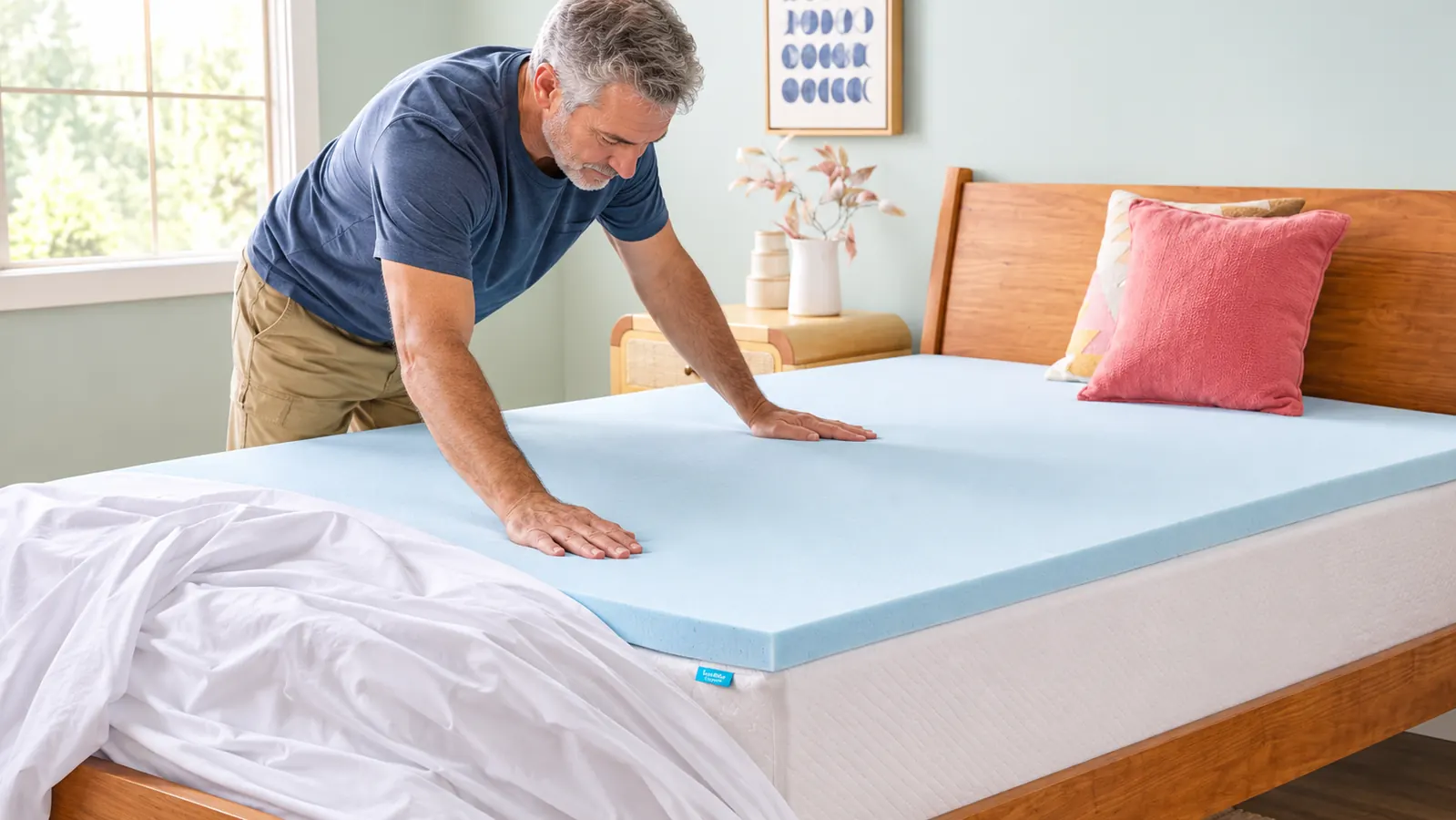
The topper arrives compressed and rolled. You open the package, unroll it on the mattress, and wait. The listing says it expands, and it does, but not instantly and not while you are standing over it tapping your foot. Mine took a solid two days to reach its full 2 inch plush height, and the corners were the last to come around. The first night I slept on it, it felt thinner than it does now.
By the end of the first day it was close to an inch and a half at the center and less at the head end. By the second morning I could lay a ruler across the middle and get the full two inches, though the corners still felt soft under my hand. I gave it a third day anyway, mostly because I had already spent one night on it and knew better than to judge foam while it was still waking up. If you open yours on a Friday, plan to sleep on it Saturday at the earliest and judge it properly on Monday.
Give it a flat spot in an aired-out bedroom with the door open. Do not make the bed right away, and do not put a mattress pad over it while it is still catching up, because the weight will keep the foam from filling out. I made that mistake with a different pad years ago and ended up with a permanently thin corner on Rick's side.
One thing from the listing worth repeating: the topper is spot clean only and not water resistant. That matters for those of us having night sweats. The fitted sheet over it is doing real work. If you sweat through, blot the foam with a barely damp cloth and let it air dry completely before the sheet goes back on. In practice that means cover it and wash the cover, not the foam. There is also a three year manufacturer warranty, which tells you the foam is meant to last longer than one summer.
Step 3: Change What Sits Between You and the Foam
This is the step most people skip, and it made the biggest difference for me. A gel topper works by pulling heat off you and spreading it out. If you put a thick quilted pad and a heat-holding sheet on top, you have built a wall between yourself and the thing that was supposed to help. Strip the bed back down to the topper, then plain cotton sheets, then one light layer.
I tried a bamboo blend first because it felt cool in my hand in the store. It actually slept warmer than the cotton percale I ended up with, which surprised me until I thought about how tightly it was woven against the skin. Percale is a looser weave and lets air move through it. I am not going to tell you a thread count number matters more than how the cloth feels, because in my experience it does not. What matters is that air can pass through the fabric and that the underside is not brushed or fuzzy.
I swapped the polyester set for cotton percale and removed the quilted mattress pad entirely. The first night felt cooler within twenty minutes. Not cold, mind you. Just no longer stuffy. Rick noticed nothing, which is exactly what you want from a change like this.
For a blanket, a cotton waffle weave or a light quilt beats anything with a fuzzy finish. If you run warm but your feet run cold, that is easy: keep a separate light throw at the foot of the bed so it warms your feet without adding heat to your torso.
A gel layer under a quilted pad and a polyester sheet is a cooling system with two doors shut.
Step 4: Cool the Room, Not Just the Bed
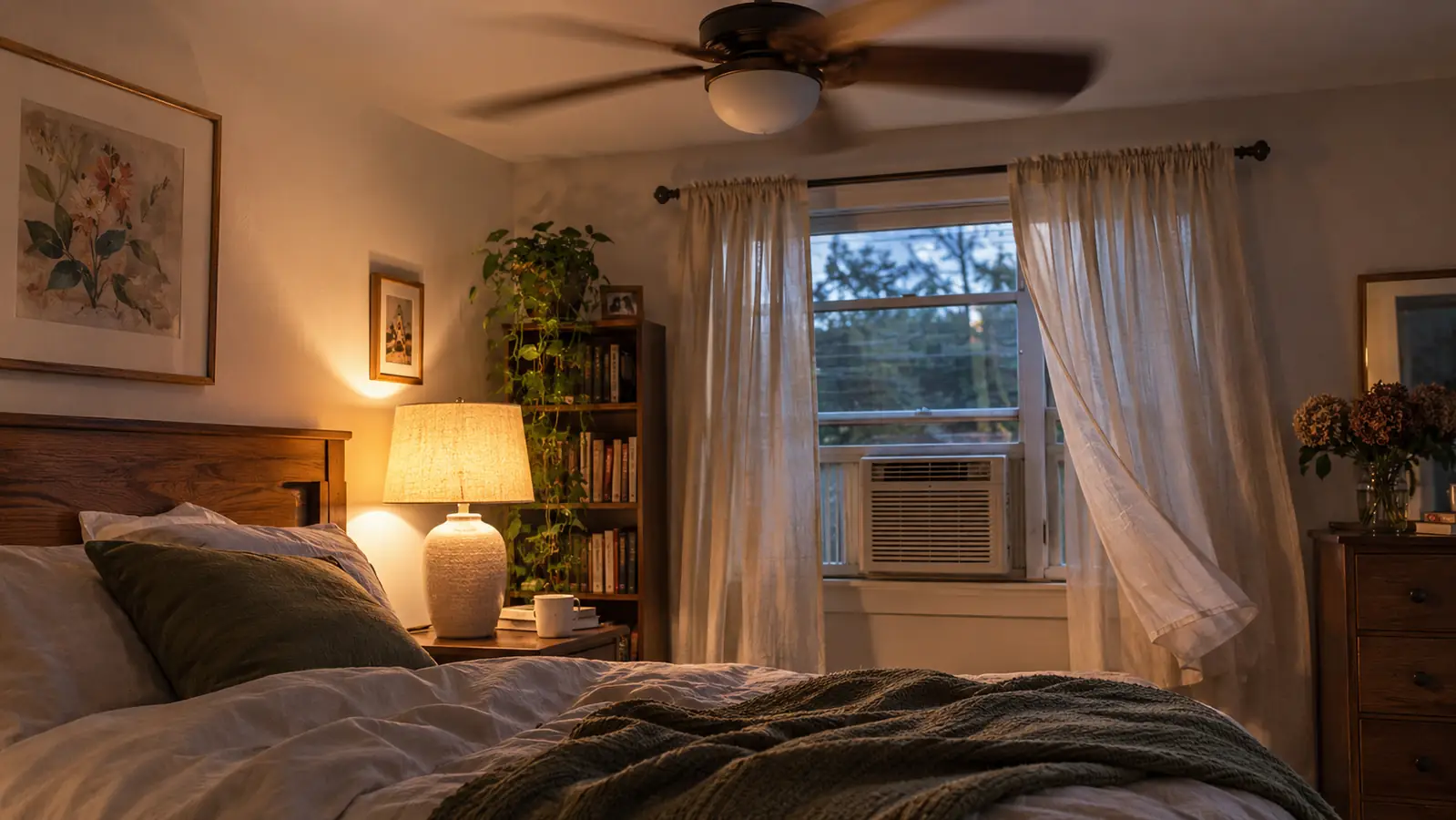
The gel captures and distributes heat. It does not create cold. If your bedroom is 78 degrees at bedtime, the topper will move that warmth around and you will still be awake at two. Our upstairs runs warm in summer, and the difference between a fan aimed at my face and an actually cool room is the difference between a bad night and a decent one.
Our bedroom thermometer read 79 one night in July and 74 the next, and on the second night I slept through until five without waking once. That is the whole argument right there. I set the window unit to 68 and let it run from eight in the evening, which sounds wasteful and turned out to cost less than I expected, and I shut the bedroom door at dusk so the cool air stays in the room instead of drifting down the stairs. On the nights I forget to do it early, I can feel the difference by ten.
Set the ceiling fan to run counterclockwise in summer so it pushes air down on you. Take a lukewarm shower before bed rather than a hot one, even though the hot one feels better going in. If you have a window air conditioner, run it earlier than feels reasonable so the room is already cool when you get in, rather than cooling down around you while you sweat.
I also moved my phone charger out of the bedroom, which has nothing to do with temperature and everything to do with how long I lie there thinking about being hot.
Step 5: Settle the Two-Blanket Problem
Rick is 57 and sleeps cold. He wants the extra blanket. I want the window open. For years we negotiated every single night and we both lost. What finally worked was two separate blankets on one bed, his heavier and mine light, each on our own half. It looks less like a magazine and more like a dorm, and I stopped waking up because someone had pulled the covers up to my chin.
The Linenspa topper helps here too, in a way I did not expect. A plush 2 inch surface cushions the hips and shoulders, so I am not shifting around trying to get comfortable, and less shifting means less trapped heat underneath me. It also means the sheet stays put, which matters when you are throwing blankets off at three in the morning and want to find them again.
If you are both running hot, skip the negotiation entirely and go straight to two light blankets. Nothing about cooling a bed requires a shared duvet, and I wish someone had told me that five years ago.
What Else Helps
Keep a glass of water and a small towel on the nightstand. This is not a cure, it is damage control. Waking up drenched is worse when you have to walk to the bathroom to find a towel. I keep a folded hand towel on the shelf and swap it for a fresh one every couple of days, which takes no thought at all.
Cool the pillow, not just the bed. Pillows hold heat badly and they sit right under your head, so a pillow you can flip, or a second pillowcase you can swap in the middle of the night, is a cheap improvement. I change the pillowcase every other day in summer and keep the spare folded in the nightstand drawer. It takes ten seconds to swap and it is the closest thing to a fresh start at three in the morning. Wash your sheets more often than you think you need to as well. Sweat and body oils cut airflow through the fabric, and a sheet that has been slept on for two weeks sleeps warmer than a fresh one. That is not a moral judgment, it is just how cloth works.
When we travel, I take a thin cotton sheet from home in the car. Hotel bedding is almost always heavier than what I sleep under now, and one bad night away is enough to remind me how much of my sleep depends on the setup rather than on luck. It is not a complicated fix, it just has to be done before you are too tired to do it.
Finally, the part I am not qualified to give. If your night sweats are soaking through, if they come with palpitations or chills, or if they started suddenly rather than gradually, that is a conversation for your own doctor. I am a retired school librarian with a warm bedroom and a strong opinion about blankets. I can tell you what helped me sleep, and that is the whole of my authority.
Start with the layer you sleep on, then work outward
The Linenspa 2 inch gel memory foam topper in queen size arrives rolled, expands over about two days, and sits under a plain cotton sheet. Steps one through five get a lot easier once it is on the bed.
Amazon Check Today's Price on Amazon →