
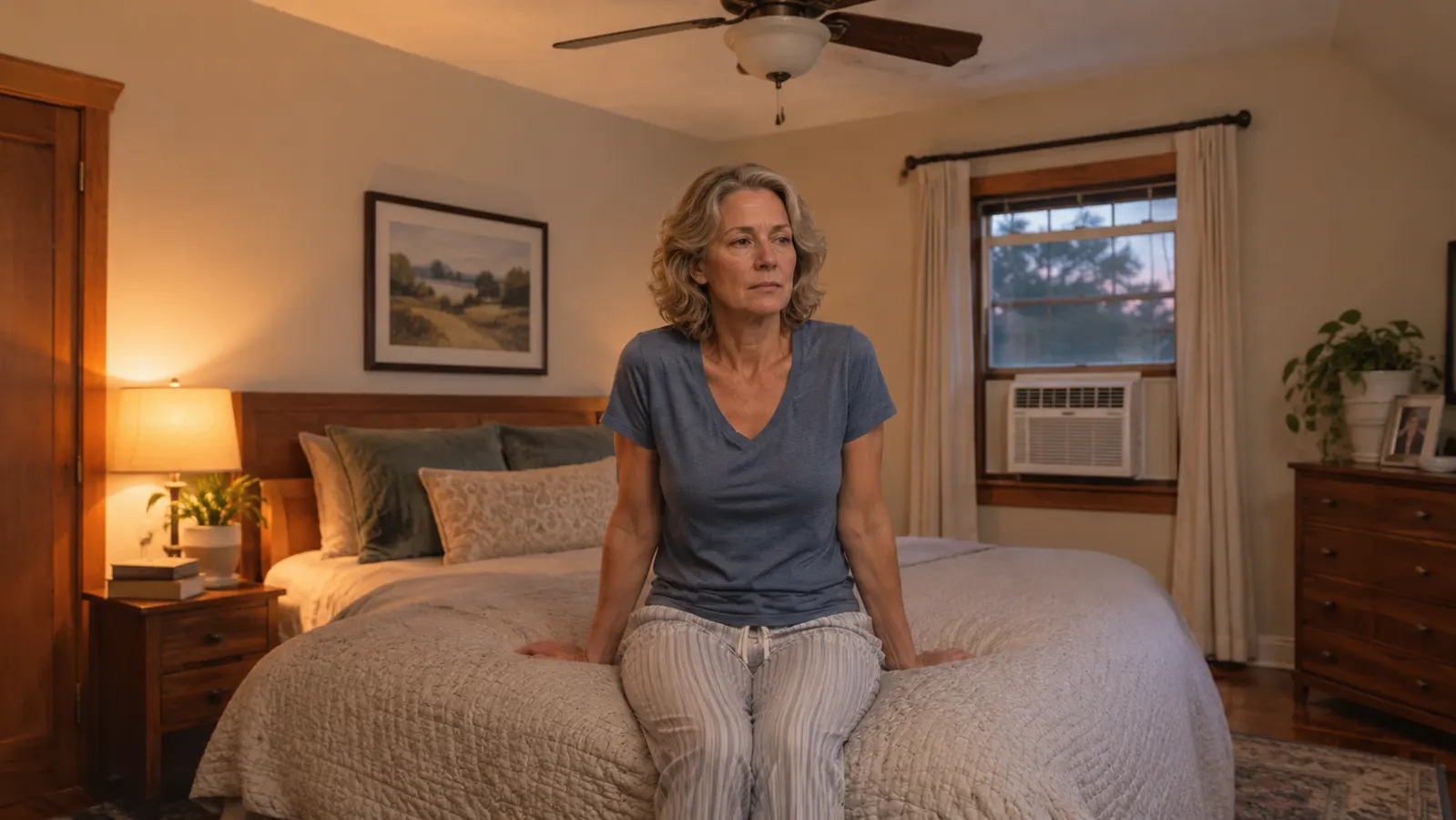
For about three years my night sweats have kept their own schedule. I go to bed around 10:30, I am asleep by 11, and somewhere near 2:15 I wake up with the back of my neck damp and the sheet stuck to my legs. I am 54, I spent 29 years as a school librarian, and I have exactly one bedroom to work with, so I could not rebuild the room. I had to rebuild the bed.
What I tried first was obvious and a little stupid. I threw the covers off, which woke Rick, who sleeps cold and wants a blanket over him in July. Then I aimed a fan at my face, which dried my eyes out and did nothing for the sheet under my back. Then I bought two sets of sheets that were described as cooling and were not. The Bedsure bamboo set was the third one, and it is the first one where I could tell the difference by morning instead of by the label.
The Layer You Actually Sleep On Is the One Worth Changing
I spent two summers rearranging fans before I admitted the sheet was the problem. Bedsure makes a 100% rayon derived from bamboo set, breathable and moisture wicking, that stayed dry against my back on nights when my old cotton set did not.
Amazon Check Today's Price on Amazon →The Five Steps, in the Order I Would Do Them Again
Step 1: Find Out What Is Actually Against Your Skin at 2 A.M.
Start by lying on your bed in the afternoon with the lights on and noticing what is under you. I know how that sounds. But when I actually did it, I found three layers: a quilted mattress pad I had washed maybe twice in six years, a fitted sheet, and a waterproof protector I bought when the kids were small and never took off. That protector was a sheet of plastic. I had been sleeping on a plastic bag and wondering why my back was wet.
The mattress pad is the layer nobody thinks about. Mine was polyester fill with a brushed surface, which is warm by design. I swapped it for a thin cotton pad and the change was immediate, and it cost less than a set of sheets. If you only do one thing from this article and you are not ready to buy anything at all, do that, then come back to the sheets.
Then look at the sheet itself. Cotton percale is crisp and I still like the feel of it against my hand, but it holds moisture close to you. The Bedsure set is 100% rayon derived from bamboo, and the listing calls it breathable, moisture wicking, and soft and silky. Breathable and moisture wicking are the two words that mattered to me. It feels cool when you get in, and more importantly it does not feel damp at 2 a.m. the way my old cotton set did.
Step 2: Fit the Sheet Properly, Because a Rucked Sheet Wakes You
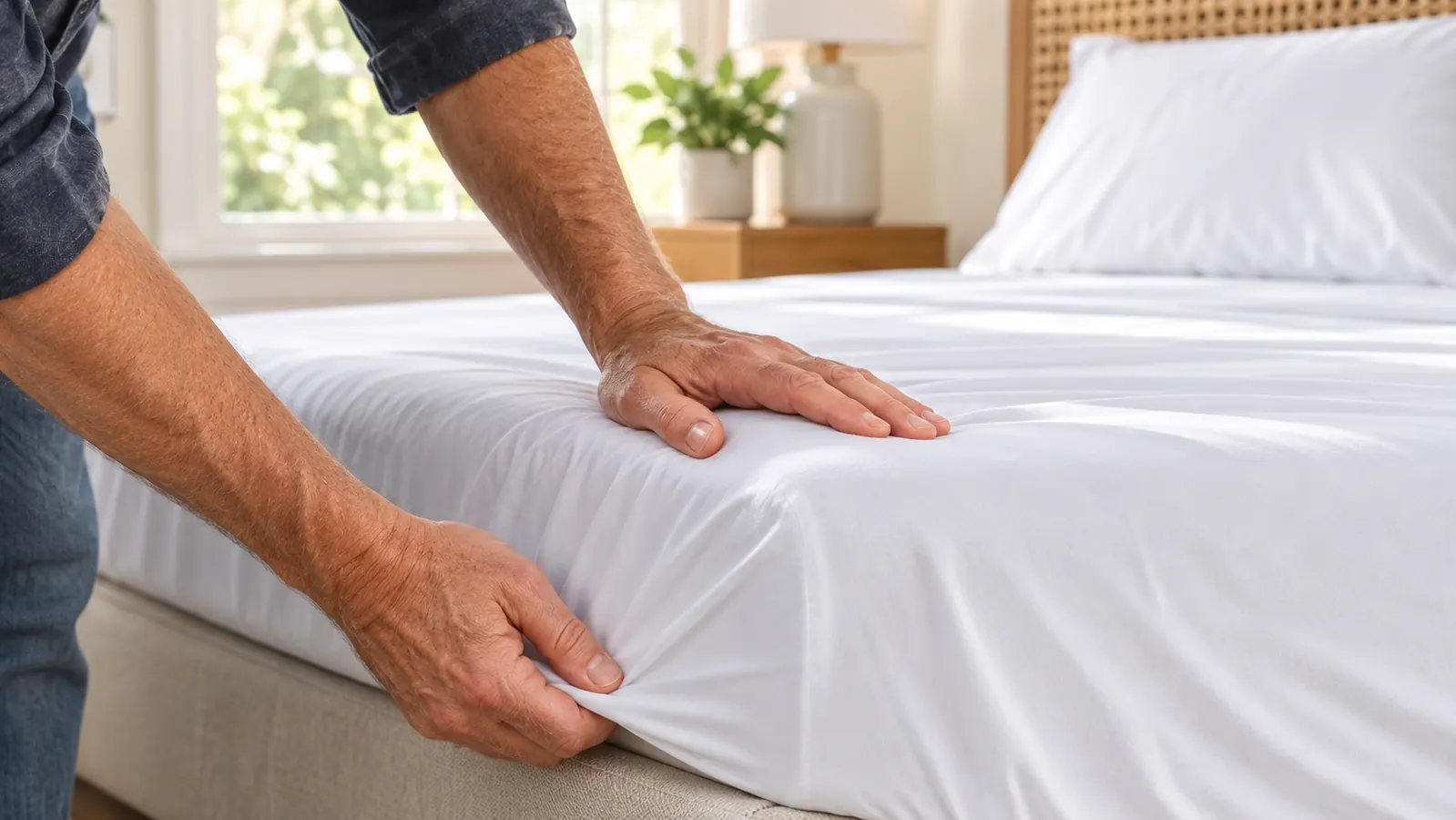
A fitted sheet that pops off the corner at midnight is worse than a warm sheet, because now you are awake and annoyed and wrestling with fabric in the dark. My old set did that about twice a week. The Bedsure fitted sheet has a 16 inch deep pocket with a full 360 degree elastic band, and my mattress plus the thin cotton pad is nowhere near 16 inches thick, so the elastic tucks well under and stays there. I have not had a corner come loose since I put it on.
Wash it before the first night. Not because of anything alarming, but because the sizing settles and new fabric has a finish on it that makes it feel stiffer than it will after one wash. Cold water, gentle cycle, low heat or hang it. I drape mine over the stair rail and it is dry in an hour in July.
The set is four pieces: a flat sheet, a fitted sheet, and two 20 inch pillowcases with envelope closures, so the pillow ends tuck in and do not slide out overnight. That sounds like a small thing until you have spent a night with a pillowcase that has worked its way half off. The whole set weighs 3.1 pounds, light enough that a load of laundry is the sheets plus a couple of towels. It also carries OEKO-TEX Standard 100 certification, number 24.HCN.19195, which is a testing standard for harmful substances. I like knowing that. I like sleeping on it more.
There are over 25 colors, which reads like a marketing line until you are trying to match a bedroom you have been adding to for twenty years. I did not need a statement. I needed something that did not fight the quilt my mother made. That is a strange thing to care about at 54 and I care about it anyway.
The first week I slept on them, I woke at 2:15 out of pure habit, and my back was dry. That had not happened in months.
Step 3: Build a Two-Zone Bed Instead of Arguing About the Thermostat
Rick sleeps cold. He wants a blanket over his shoulders even in August, and I want nothing on my legs. For two years we fought about the thermostat, which is a fight nobody wins, because the number that makes him comfortable is the number that wakes me up sweating. The answer was not a compromise. The answer was two separate systems on one bed.
What we do now: one flat sheet across the whole bed, then a light blanket folded in half on his side only, and nothing on mine. I keep the Bedsure flat sheet over me from the waist down on cooler nights, and I fold it back on the nights when I know I am going to run hot. It is light enough that having it on does not feel like a mistake, which was never true of the heavy cotton set I used to use.
One warning about this arrangement: it only works if the flat sheet is wide enough to cover one person on one side. Ours is a queen flat sheet on a queen bed, so when Rick pulls his half up over his shoulder, my half does not follow. That took me one night to check and about two weeks to stop yanking it back.
I also keep a spare flat sheet folded at the foot of my side, so if I wake up damp I can pull it over and go back to sleep without getting up and stripping the whole bed. That sounds small. It is the difference between a two minute wake-up and a forty minute one at 3 a.m.
Step 4: Move the Air in the Room, Not the Number on the Thermostat
Our bedroom is upstairs in a 1960s brick two-story and it runs about five degrees warmer than the downstairs in July. That is just physics in an old house. I cannot fix the house. What I could do was stop trying to cool the whole upstairs and start moving the air in the one room I actually sleep in.
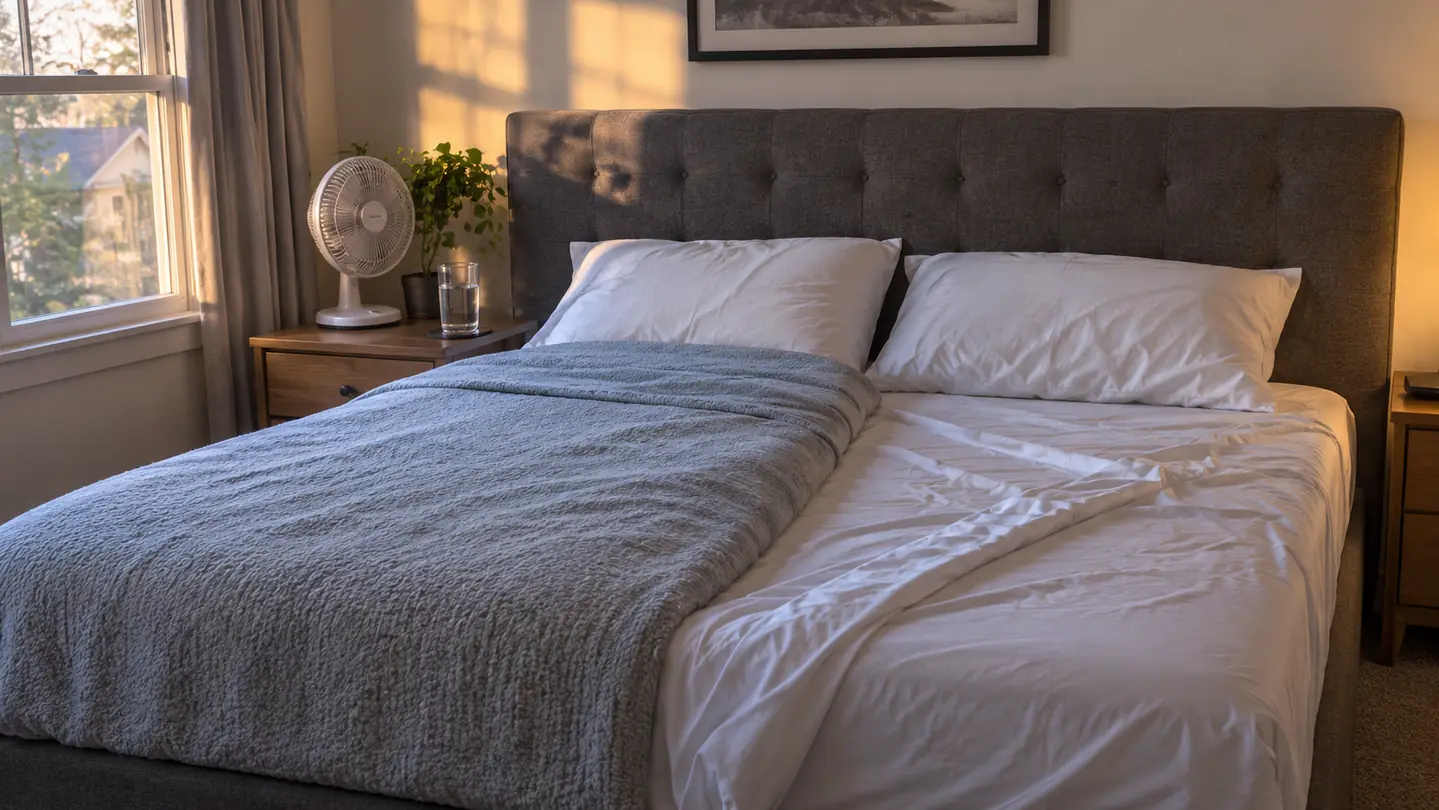
The ceiling fan runs on medium all night. There is a little switch on the motor housing that reverses the direction. In summer it should turn counterclockwise, which pushes air down so you feel it on your skin. In winter you flip it the other way at low speed. I ran mine backwards for two summers before I worked that out.
The window air conditioner goes on about an hour before bed, so the room is cool when I get in, not cool at midnight when I am already awake and cross. I also learned not to point it at the bed. Cold air on my face at 3 a.m. gives me a headache. Aimed up toward the ceiling, it cools the room without the draft. One caution: do not set it to the lowest setting and lie under it. I did that in June and spent a week with a stiff neck. Cool room, moving air, not cold air on your body.
The last thing I did was stop closing the bedroom door during the day. An upstairs bedroom in an old brick house bakes all afternoon. If the door is shut from 8 a.m. to 9 p.m., you are climbing into an oven at 10:30 no matter what the air conditioner is set to. Door open, fan on, and the room is at a reasonable temperature by the time I want it.
Step 5: Change the Hour Before Bed, Not Just the Bedding
The last step is not about bedding and it is the one I resisted longest. A warm shower an hour before bed sounds like the wrong move when you already run hot. It is not. You get out, your skin cools, and that drop is one of the signals your body uses to get sleepy. I take mine at 9, I am in bed at 10:30, and I fall asleep faster than I did when I was skipping it.
I also moved my last cup of coffee. I used to have one at 4 in the afternoon, which is a habit left over from 29 years of school days. Caffeine at 4 is still in you at 10. I switched to decaf or nothing and the falling asleep part got easier, which meant the waking at 2 part did not feel like the end of the world.
And the wine. I am not going to lecture anybody, and I am not a doctor, so take this as one woman's notes. A glass at 8 made me fall asleep faster and wake at 2 with my heart going. I moved it earlier or skipped it and the 2 a.m. wake-ups got less frequent. If your night sweats are severe, or you are soaking through sheets most nights, that is a conversation for your doctor and not a bedding article. Mine are a few nights a week and I have talked to mine about it.
What Else Helps
A few smaller things that made the list. A cotton nightgown instead of the synthetic one, because the synthetic one trapped heat against my back. A second pillow so I can flip to the cool side at 2 a.m. without rearranging the whole bed. A glass of cold water on the nightstand so I do not have to go downstairs, which is how I used to end up wide awake on the couch at 3.
A note on pillows while I am here. I had a memory foam pillow I loved for about five years and gave up on, because foam holds heat and by 2 a.m. the underside was warm. A plain pillow with a cotton case is cooler. The two cases in the set are 20 inches wide and the envelope closure keeps them on, which matters more than it should when you are half asleep and hot.
I also stopped making the bed tight. If you tuck the flat sheet in hard at the foot, you build a little oven around your feet. I leave the foot of the bed loose and let the sheet rest on top of me rather than wrapping around me. Small thing. Noticeable thing.
The mattress itself I did not replace, and I want to say that plainly because almost every article on this subject eventually tells you to buy a new mattress. Mine is eight years old and it is fine. If yours is fifteen years old and has a memory foam topper that has gone soft, that topper is a heat trap and is worth looking at. But you do not have to start there, and you do not have to start with a new bed.
One more, and then I will stop. I eat earlier and lighter on the nights I know are going to be bad. A full dinner at 8 made the first two hours of sleep restless, and restless sleep for me turns into a wake-up at 2. That is not a rule I would hand to anyone else and it is not medical advice. It is just what the notebook by my bed kept telling me.
None of this is a cure and I want to be honest about that. I still wake up some nights. But the difference between waking on a damp cotton sheet and waking on a sheet that feels dry is the difference between being awake for an hour and being awake for ten minutes. Bedsure was the third cooling set I tried and the first I would buy again. That is the whole review, really.
If Your Side of the Bed Runs Hot, Start With the Sheet
Four pieces, 16 inch deep pockets with a full 360 degree elastic band, and a fabric that wicks instead of holding. It is the cheapest layer of this whole setup to change, and the one you are against for eight hours.
Amazon Check Today's Price on Amazon →