

The first hot flash that woke me at two in the morning sent me digging under my head for the cool side of the pillow. I found it. I put my cheek down and waited. Ninety seconds later the cool was gone, replaced by a warm dent that felt like it had been made by somebody else. I repeated that flip and wait routine for about three years before I admitted to myself it was not a strategy. It was a habit, and not a good one.
What finally changed my nights was a QUTOOL cooling pillow, and the more useful thing I learned along the way is that the pillow is only half the job. The other half is everything you do around it. I am 54, a retired school librarian, and I live outside Harrisburg, Pennsylvania, in a 1960s brick two story where the upstairs runs a few degrees warmer than the downstairs all summer. My night sweats started around 51 and they still wake me a few nights a week. I am not a doctor and I am not going to pretend to be one, so anything here that sounds medical is really just a nudge to call yours. What follows is what actually helped in my own bedroom, in the order I would do it again.
Start With the Thing You Put Your Face On
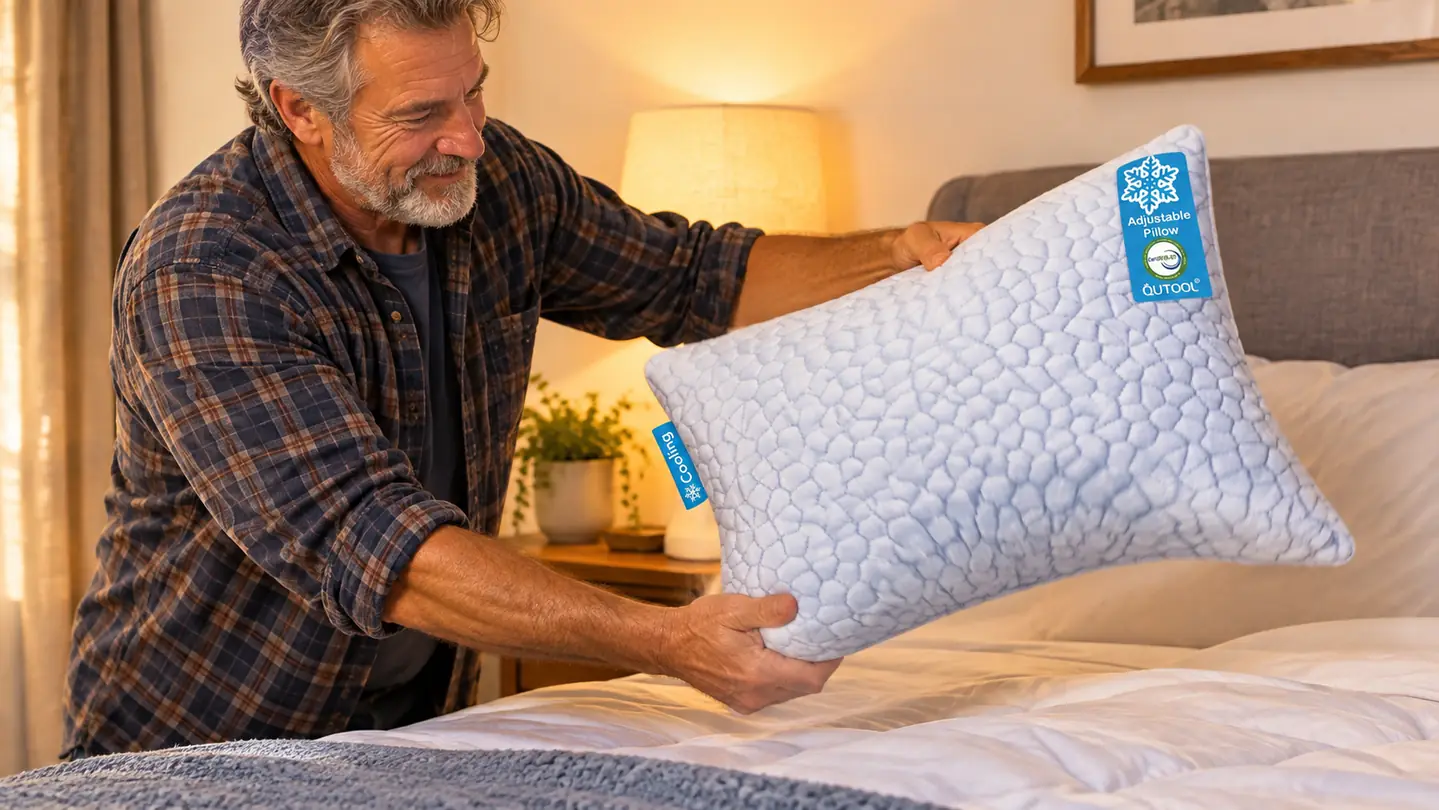
The QUTOOL set gives you two queen pillows, a cooling face on one side and a soft side on the other, and fill you can take out by the handful until it suits your neck. That is where I would begin.
Amazon Check Today's Price on Amazon →Step 1: Take Some Fill Out Before You Judge Anything
A shredded fill pillow arrives stuffed like a Christmas stocking, and most people sleep on it that way for a week, decide it is too firm, and give up. I did exactly that with my first one. The QUTOOL is filled with 85 percent cross cut memory foam and 15 percent soft microfiber, and the entire point of that construction is that you can take some of it out. The listing calls it adjustable. Believe it.
Take out two big handfuls of fill, close it back up, and sleep on it one night before you decide anything. If your ear aches in the morning or your jaw feels pushed up, take out two more handfuls. If your neck feels unsupported and your chin drops toward your chest, put a handful back. It took me four nights and three adjustments to get mine right, and I have not touched the fill since. The spare goes in a grocery bag in the closet, because in a year or two you may want it back.
The adjustable fill is also what makes these work for the way you actually sleep, rather than the way you sleep in your imagination. I start on my side and end up on my back, and the same pillow handles both once the fill is set. Rick, who sleeps cold and has opinions, took the second pillow out of the set for the guest room and now complains when we have guests. The listing puts the item weight at 7.3 pounds for the set, which is heavier than a feather pillow and lighter than a solid foam brick, and that weight is most of why it stays put instead of sliding off the bed in the night.
Step 2: Sleep on the Ice Side and Give It a Head Start
The QUTOOL cover is double sided. One side is a silky ice fabric, described on the listing as 50 percent of the blend on that side, and the listing says that face helps lower the surface temperature by about 4 to 9 degrees Fahrenheit. The other side is a softer fabric for anyone who finds the cool side too slippery or too much of a change. I sleep on the ice side from June through September and turn it over in November.
Here is the part people skip, and the listing actually says it out loud: all fabrics used on bedding are affected by the temperature of their surroundings. That is not a disclaimer, it is the whole physics of the thing. A cooling pillow in an eighty degree bedroom is not a cold pillow. It is a pillow that takes longer to warm up to eighty. The fabric gives you time. It does not give you cold air.
So give it a head start. Ten minutes before bed, turn the pillow cool side up and leave it out from under the covers where the fan can reach it. Do not stack a second pillow on top of it, and do not tuck it under your arm while you read. If your bedtime routine involves washing your face, dry off properly before you lie down. A damp cheek on a cool pillow feels wonderful for about four minutes and then it feels like a wet pillow, which is worse than a warm one. I learned that the hard way in July.
One warning about the first night: the ice side feels almost cold when the room is already cool, and a few people find that unpleasant. Rick did. He turned it to the soft side and slept fine and has never gone back. So if you try the cool side in April and hate it, put it away and try again in July, when your bedroom is genuinely warm and the cool face feels like relief instead of a shock.
Step 3: Cut the Layers Between You and the Pillow
Rick wants a blanket. I want nothing but a sheet, and even the sheet is negotiable by two in the morning. For years we fought this out at three in the morning with a lot of sighing and a certain amount of tugging. What fixed it was separate bedding on one mattress: a light quilt on his side, a single cotton sheet on mine, and no top sheet tucked under my side of the mattress. Two settings, side by side, in the same bed.
The pillow has the same problem in miniature. Anything between your cheek and the ice fabric cancels it out. A thick quilted pillow protector, a flannel sham, a decorative case that stays on all night, all of those are a blanket for your face. I use a plain cotton pillowcase over the cooling side and nothing else, and I change it twice a week in summer. When I want the full effect I take the case off entirely, which sounds fussy and is not.
One more thing nobody mentions: your own hair. Mine is shoulder length and I used to go to bed with it damp after a shower. A damp head plus a cooling pillow equals a pillow that never gets to be cool. I shower earlier now, and I pull my hair up off my neck. It made more difference than the fan did, and the fan made plenty.
Step 4: Cool the Room Before You Get In It
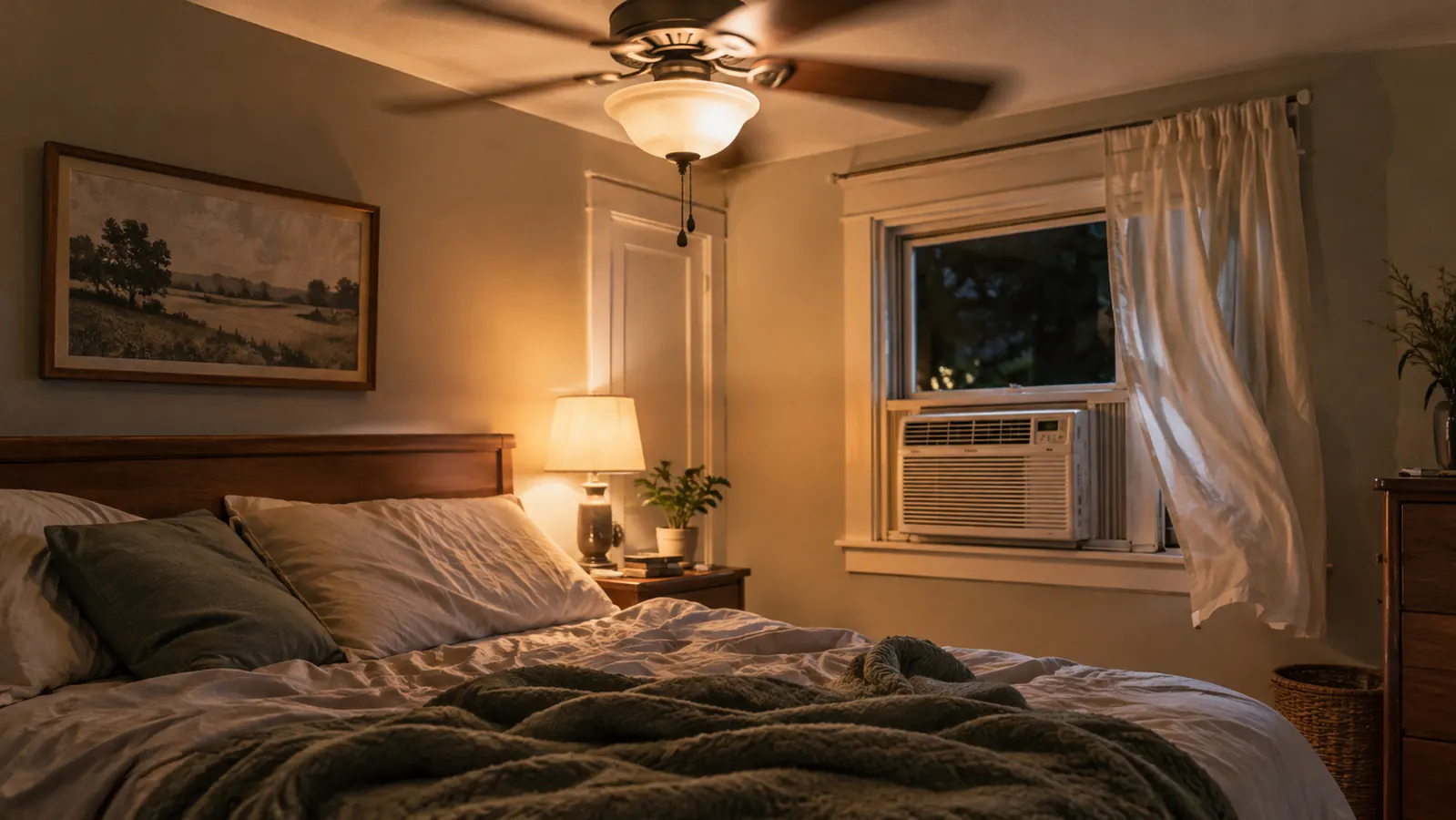
We have one window air conditioner and one ceiling fan upstairs, and the upstairs bedroom in this house is the warmest room in it from June through September. The single best change I made was to start the air conditioner an hour before bed instead of when I got into bed. Cold air takes time to move through a room and soak into walls and bedding. Starting it late means you fall asleep in a warm room and wake up at one in the morning when the machine finally catches up.
The ceiling fan does not lower the temperature of anything. What it does is move air across your skin so moisture evaporates faster, and that is the cooling you feel. It only works if the air can actually reach you. In our room that meant moving the fan from the middle of the ceiling to over the foot of the bed, because the pull chain hung exactly where the air needed to go. A longer chain and a screwdriver solved it on a Saturday morning.
Two smaller things. Close the curtains on that side of the house by mid morning, because a brick wall holds heat like a baking stone and you will feel it at nine at night. And leave the bedroom door open during the day so the hot air is not trapped in a closed box for ten hours before you get home. I also moved my last cup of coffee to noon, which I resented and which helped.
The order matters, by the way. Cool the room first, then the bedding, then you. Running the air conditioner with the bedroom door open and the hall fan on moves that cold air around the upstairs instead of pooling it in one room. I figured that out in our second summer here, after a July where I slept on the couch four nights in a row because the bedroom was a sauna and the couch was at least downstairs.
Step 5: Care for the Cover So the Cool Side Keeps Working
The care instructions are short, and people ignore them, and then wonder why the cool side quit on them. You machine wash the cover. You air dry it, no heat. You do not wash the inner filling. That is the whole list. A hot dryer on a silky cooling fabric is a fine way to ruin the finish that makes it feel cool in the first place, and a washing machine full of shredded memory foam is a story with no happy ending.
When the pillows first arrive, the listing suggests letting them air out for about a day or two before you sleep on them. Do that. Ours had a faint foam smell straight out of the box that was gone by the second afternoon. Mine went out on the screened porch rather than in direct sun, and came back smelling like nothing at all.
Because the set gives you two, rotation is easy. I keep one on the bed and one in the closet and swap them every few days, which means the cover gets washed more often and the fill gets a rest in between. It also means that on a bad night, when the pillow has gone warm and my temper has gone with it, there is a genuinely cool one within arm's reach. That sounds like a small thing. At two in the morning it is not a small thing.
A cooling pillow does not make a hot room cool. It gives you the first twenty minutes, and twenty minutes is often the whole difference between falling asleep and lying there listening to the fan.
What Else Helps
Two things helped almost as much as the pillow and cost nothing at all. The first was getting up. When a night sweat wakes me, I get out of bed, walk to the bathroom, and stand there for two minutes instead of lying in the damp getting cross. Whatever is happening passes faster when I am upright and moving than when I am lying still in the middle of it. The second was a glass of cold water by the bed in a cup with a lid, so I do not knock it over at three in the morning, which I have done twice.
The rest is worth a conversation with your doctor rather than a blog post from a retired librarian. Night sweats that wake you several nights a week are worth mentioning at your next visit, and there are things a doctor can check that a pillow cannot fix. I am not on hormone therapy and I am not going to tell you what to do about that. What I will tell you is that a cooler bed made the nights I do wake up shorter, and the nights I sleep through more frequent, and that was enough to be worth the trouble.
One last note for anyone sharing a bed with a person who sleeps cold. Make the cool side of the bed a zone, not a compromise. Rick has his quilt, I have my sheet, and the fan points at me and not at him. It took us a while to stop negotiating every night at bedtime, and the answer was never a middle setting. It was two settings, side by side, in the same bed, with a pillow that has two sides of its own.
Two Pillows, Two Sides, and a Better Two in the Morning
The QUTOOL set gives you a cool face for summer, a soft face for winter, and fill you can adjust until your neck stops arguing. If hot nights are wrecking your sleep, this is the simplest place I know to start.
Amazon Check Today's Price on Amazon →