
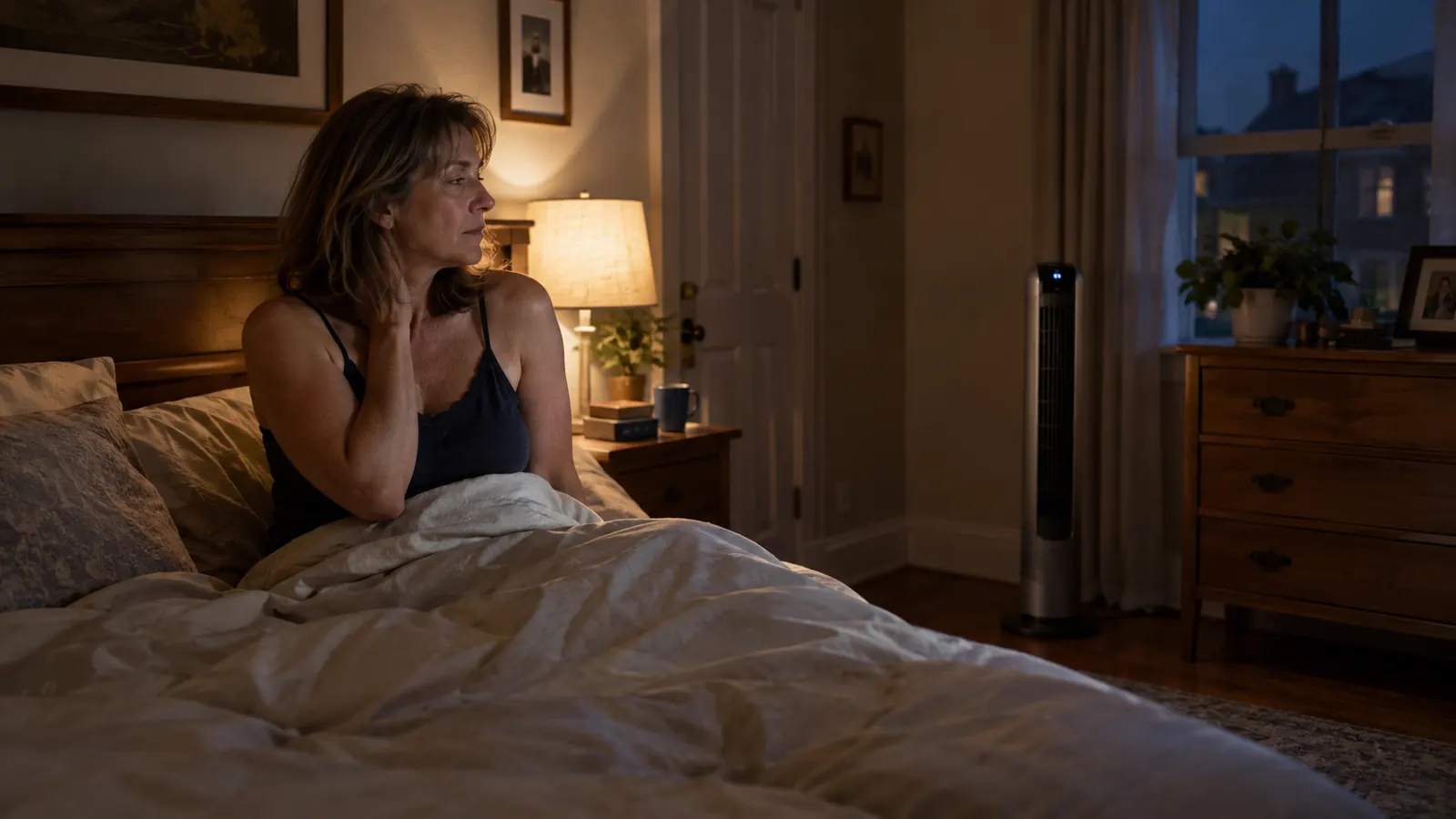
At 2:40 on a Tuesday morning, I woke up with my nightgown stuck to my back and threw the covers off like they were on fire. That was three years ago. I am 54 now, and the flashes still wake me a few nights a week. What has changed is that I am not awake for two hours afterward anymore.
Here is what I learned after a box fan, a ceiling fan, a damp washcloth on the nightstand, and one truly miserable July of sleeping on the couch. The fan matters more than anything else in that room. The one I landed on is the DREO tower fan for the bedroom, and I am going to tell you the ten specific reasons it earned its spot next to my bed. It replaced a box fan that rattled the window screen, and I have not missed that thing once. I am not a doctor and I am not going to pretend a fan is medicine. If your flashes are severe, or they came on suddenly, talk to your own doctor. What I can tell you is what made my nights bearable, and why a DREO ended up being the brand on my nightstand rather than something cheaper.
The fan that ended my 2 a.m. couch exile
31 decibels, 8 speeds, and a remote that lives on the nightstand. This is the exact model I run every night in the upstairs bedroom.
Amazon Check Today's Price on Amazon →It moves air at 28 feet per second, so you feel it in the first ten seconds
A flash does not build slowly for me. It goes from I am fine to get this off me in about ninety seconds. The DREO pushes air at up to 28 feet per second, and from across the bedroom I can feel it before the worst of it hits. That speed is the whole reason I stopped sleeping with a wet washcloth on my forehead. By the time the heat crests, there is already moving air on my face, and I can lie still instead of thrashing around looking for relief.
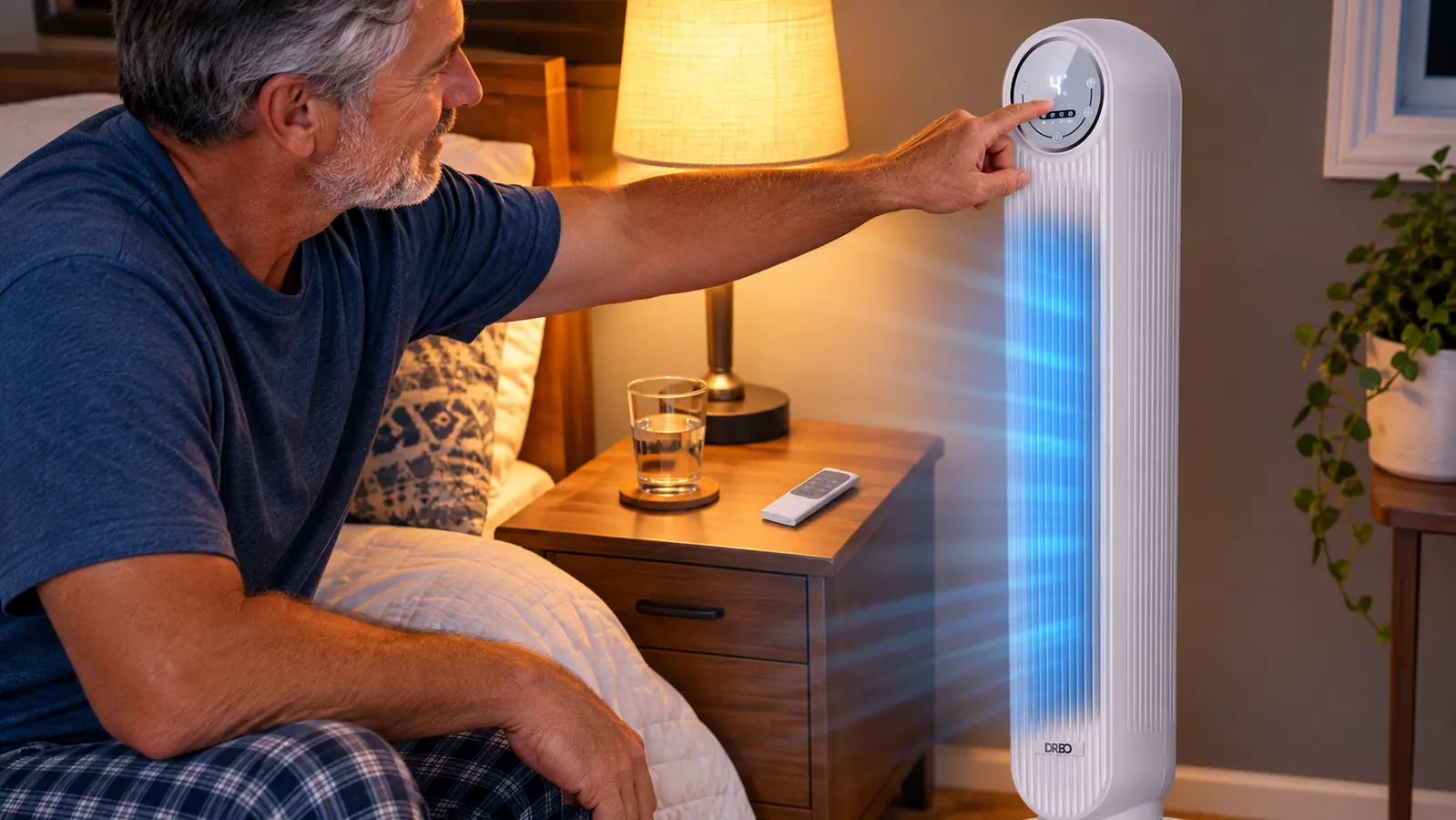
31 decibels means Rick sleeps through it
Rick sleeps cold and he sleeps light, and he has opinions about noise. The fan is rated at 31 decibels, which on the lower speeds is quieter than our refrigerator. I run it all night now. He has not complained once, and he complains about most things I bring into this house. If your partner wakes at the click of a thermostat, this is the detail that decides whether the fan stays or goes back in the box.
Eight speeds let you step down instead of switching off
Most fans I have owned have three settings: too little, fine, and hurricane. When a flash breaks at 2 a.m., what I actually want is to knock the air back one notch as the heat drains, not turn the thing off and lie there waiting for the next one. Eight speeds means I can go from 6 to 5 to 4 over twenty minutes and never lose the breeze. Small thing. It changed how fast I get back to sleep.
Sleep mode holds steady air while you drift back off
Sleep mode is one of the four settings and it is the one I use most. I do not want a fan that ramps up and down all night, and I do not want one that quits on me at four in the morning when the room has finally cooled. I want the same gentle air from the moment I get back into bed to the moment the alarm goes. That is what this gives me, and I have mostly stopped waking at dawn in a puddle.
90 degree oscillation cools the whole bed, not one shoulder
A fixed fan blasts one spot. You roll over, and now your back is hot and your ear is cold. This one sweeps through 90 degrees, so the air crosses the pillows and comes back around. I keep it near the foot of the bed and both of us get a pass every few seconds. On a bad night I turn the sweep on, lie back, and let the air come to me instead of chasing it.
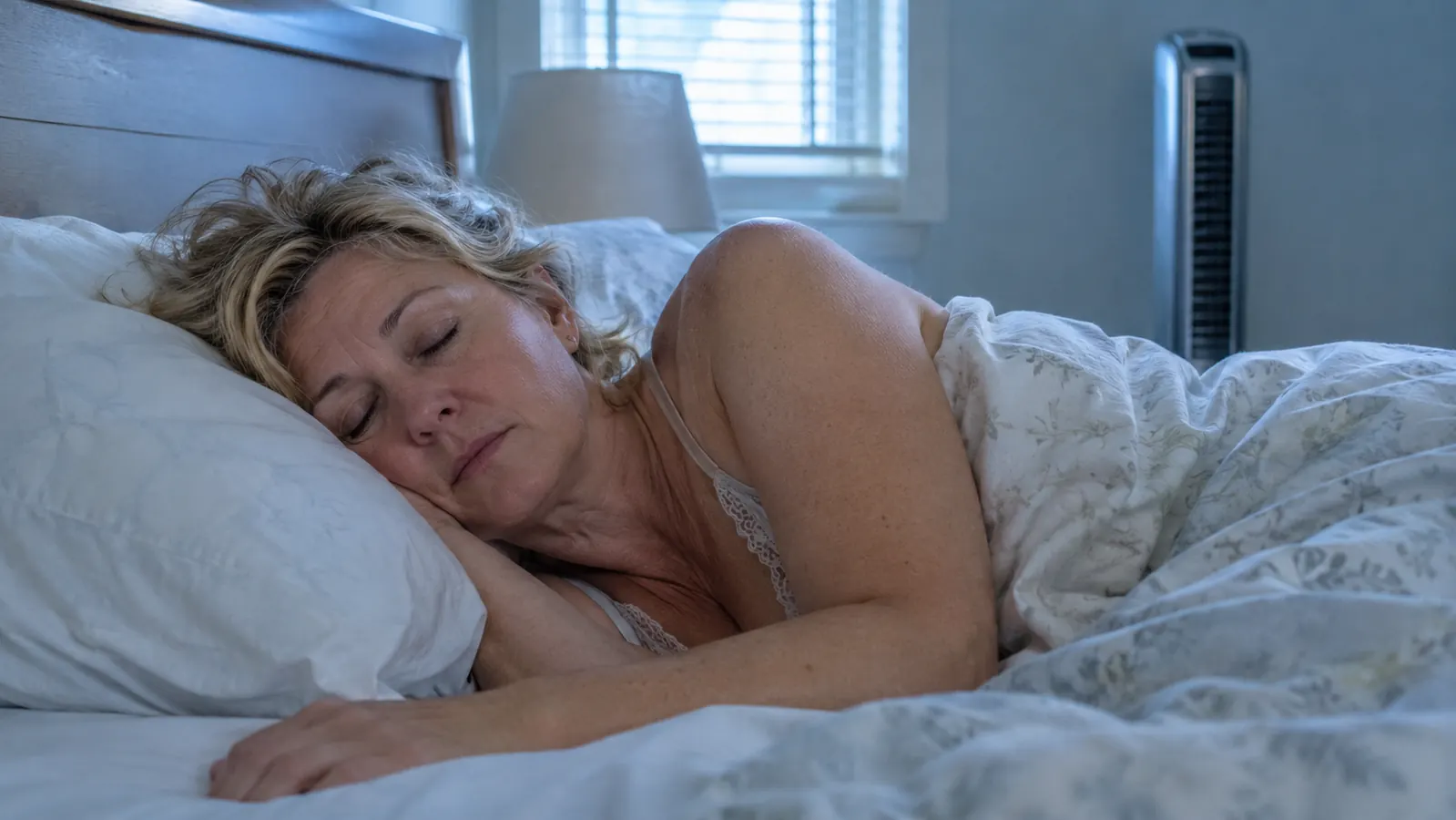
A timer means I am not standing in the dark hunting for a knob
I used to get up at 2 a.m., walk to the box fan, and crouch down to find the switch. By the time I was back in bed I was awake for an hour. With a timer I set the run time before I get in, and on the nights I wake up hot I can bump a speed and let it run for a set stretch instead of leaving it going until morning. It shuts itself off. I go back to sleep. That is the whole transaction.
The remote sits on the nightstand where your hand already is
The controls are touch on the unit and there is also a remote, which is the one I use. It lives next to my water glass. I do not have to hunt for it in the dark because it is always in the same spot, and I do not have to walk across the room and bend over. When your nightgown is soaked and your heart is going, the difference between reaching six inches and crossing a room is the difference between a two minute wake up and a forty minute one.
Natural mode breaks the airflow up so it stops feeling like a draft
Steady air on the back of my neck for eight hours gives me a stiff shoulder, and I am at the age where a stiff shoulder lasts three days. Natural mode varies the airflow instead of holding it constant, so it feels more like a screen window than a wind tunnel. I run it early in the evening while I am still reading, then switch over before I turn out the light. Small variation. It is the reason I can leave the fan pointed at me all night.
Auto mode handles the speed changes so you stop thinking about it
Auto is the fourth mode and the one I use when I want to stop managing the thing. I set it before I get into bed and it takes care of the speed adjustments through the night. That matters in our upstairs bedroom, which runs warm at ten and cool by four. Ambient intelligence is the phrase in the listing. What it means in practice is that I stop waking up enough to think about the fan, and that is worth more to me than any single item on this list. It is also the setting I recommend to friends who ask me about the DREO before they buy one.
It cools my side of the bed without freezing Rick out
This is the one I did not expect. Rick sleeps cold. He wants the extra blanket. I want arctic air on my face at three in the morning, and we have been arguing about the thermostat since 2019. Because this fan is directional and oscillates, I aim it at my side and he keeps his covers. It weighs 3.8 kg, so on the nights when he is already asleep and I am the hot one, I can pick it up and move it closer without waking him. That alone was worth it.
What I'd Skip
The box fan in the window. I did that for two summers and all it did was rattle the screen and pull in pollen. Skip the wet washcloth on the forehead too, at least as your only plan, because it is cold for four minutes and then it is just a wet washcloth. And skip anything that promises to stop night sweats. A fan moves air. It does not change what your body is doing, and you should hear that from your own doctor rather than from a fan listing. The ceiling fan still runs in our room, and it helps, but it moves air at ceiling height. What finally worked was moving air at pillow height, quietly, with the controls within reach. That is the whole case for the DREO, and it is a case I would make to any friend sitting at my kitchen table.
Thirty one decibels is quieter than my refrigerator. I know, because I stood in the kitchen at midnight comparing the two.
If you are reading this at 3 a.m., you already know
The bedroom model I run every night. 8 speeds, 4 modes, 90 degree sweep, and quiet enough to leave on until morning.
Amazon Check Today's Price on Amazon →