
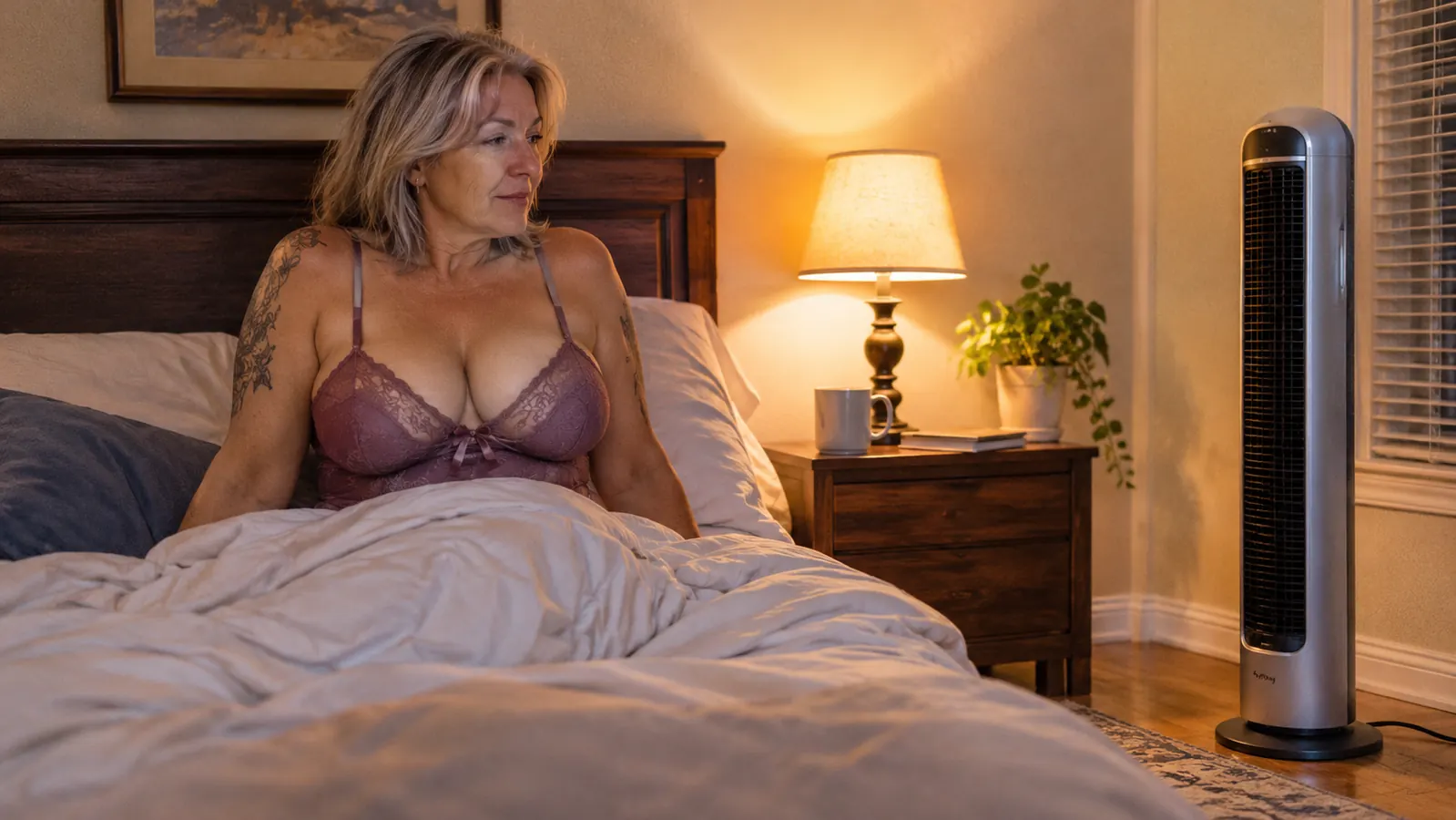
The first hot flash that woke me at 2 a.m. was three years ago. My reaction was to throw the covers off, walk to the window, and stand there in the dark waiting for my skin to stop buzzing. That got to be a routine. So did the small desk fan I balanced on the nightstand, which rattled loudly enough that my husband Rick started sleeping with earplugs. What I wanted was not complicated. Moving air on my side of the bed, quiet enough that neither of us noticed it, and a way to change the setting at three in the morning without standing up.
The DREO Tower Fan for Bedroom is what ended up in the corner of our upstairs room. It is a 28ft/s tower fan with eight speeds and four modes, controlled by touch or by a remote that arrives with the battery already in it. It has been running most nights since spring, through the stretch when my night sweats went from occasional to a few times a week. This is not a medical device and I am not going to tell you it cures anything. What I will tell you is what it did for the two hours after a flash, because those two hours are the part nobody warns you about.
The Quick Verdict
The fan I actually reach for at 2 a.m. Quiet on the low settings, easy to aim at my side of the bed, and the remote means I never have to get up mid-flash. The base takes some fiddling to assemble and the top speeds are too loud for sleeping, but after months of nightly use I would buy it again.
Amazon Check Today's Price →Quiet enough that my husband stopped noticing it
Eight speeds, four modes, 90 degree oscillation, and a remote that lives on my nightstand. This is the fan running in our bedroom right now.
Amazon Check Today's Price on Amazon →How I've Used It
Our bedroom is upstairs in a 1960s brick two-story, and the upstairs runs warm from June through September. We have one window air conditioner and a ceiling fan, and for years those two were the whole plan. The trouble is that a ceiling fan moves air over both of us, and Rick sleeps cold. He wants the extra blanket. I want a cold pillow. Turning the ceiling fan up helped me and made his night worse, which is a bad trade in a marriage.
So the tower fan went on my side, about four feet from the edge of the mattress, angled up toward the pillow. That was Rick's suggestion and it was a good one, because the airflow reaches my face and shoulders without blowing across his half of the bed. Since then I have run it on Natural mode most nights and Sleep mode when I wake up already sweating, because Sleep mode is the quietest of the four and I do not want to lie there listening to a motor while I wait to cool down.
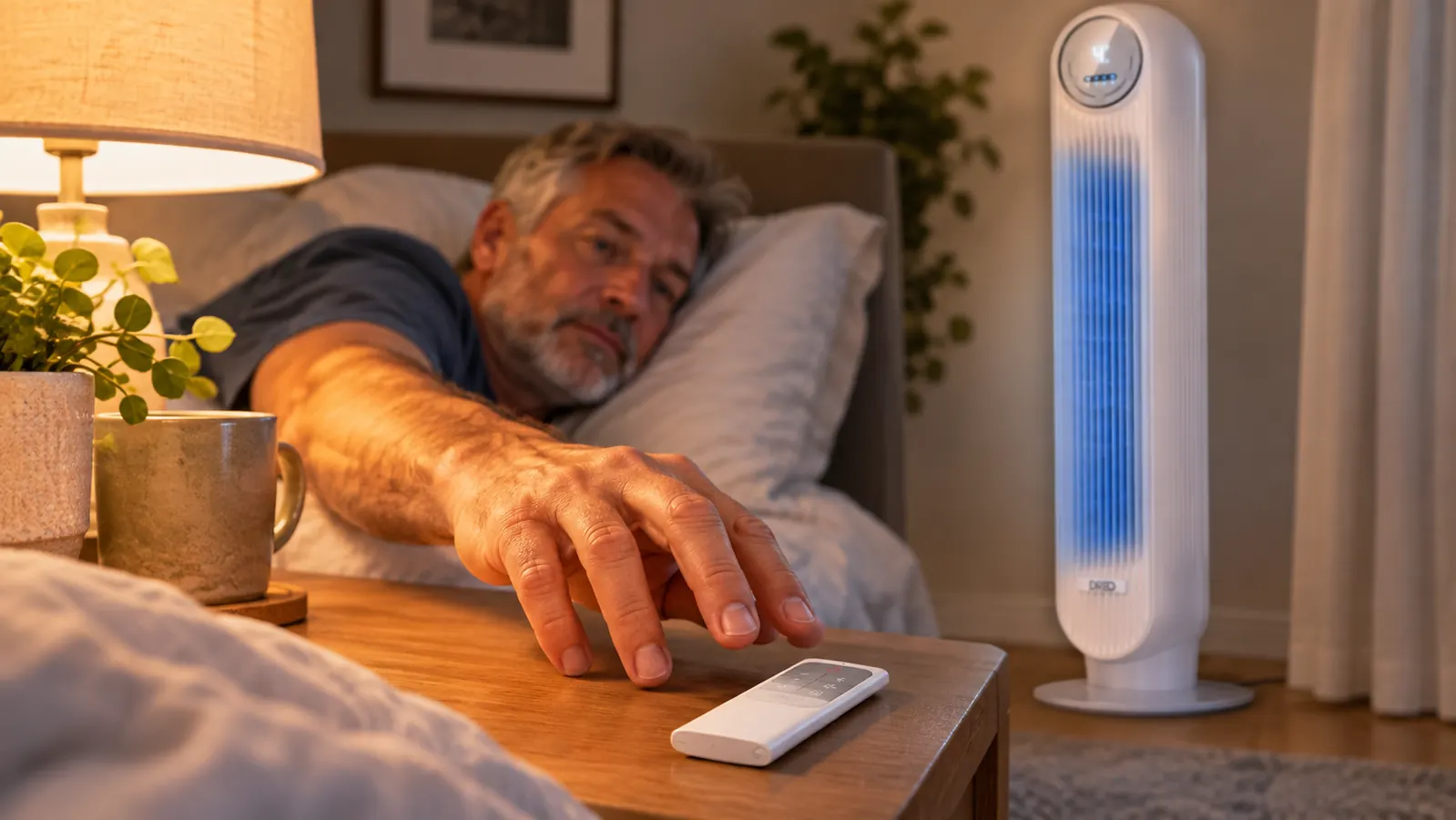
The nightly routine is not glamorous. The flash usually hits around 1:40 a.m. I sit up, reach for the remote on the nightstand, tap it a couple of times, and lie back down with the fan pointed at me. The whole thing takes maybe fifteen seconds, which matters more than it sounds like it should. When I had to get out of bed, walk to the fan, and bend down to find a button, I would be awake for an hour afterward. Now I am back asleep in twenty minutes on a good night.
One thing I got wrong early: I set it too far from the bed. The first week it sat over by the dresser, a good eight feet away, and it felt like nothing at all. Moving it to four feet and aiming it at my shoulders rather than my feet made more difference than any speed setting. If you try this, start close.
What the Eight Speeds and Four Modes Actually Do
Eight speeds sounds like a marketing number until you are the person choosing between them at 3 a.m. In practice I use three. Speed 2 for an ordinary night, speed 4 or 5 when a flash is coming and I want to head it off, and speed 8 exactly twice, both times in July when the upstairs had not cooled off by bedtime. The lower speeds move enough air to feel like a breeze across the sheet. The top end is a genuine gust and it is loud enough that I would not sleep through it, but it knocks the heat down fast.
The four modes are Normal, Natural, Sleep, and Auto. Normal is a steady stream, which is what I want when I am trying to fall asleep and do not want to think about the fan at all. Natural varies the airflow, so it feels less like a machine and more like a window left open, and that is my default. Sleep mode runs quieter, and the display dims so it is not glowing at you in a dark room. Auto hands the decision to the fan and I have used it the least, mostly because I would rather be the one deciding. Then in September, during a week when the nights swung from cool to stifling and back again, I tried Auto for three nights running. It was fine. Steady, quiet, nothing dramatic. I still prefer deciding for myself, but I have stopped thinking of it as a gimmick.
The remote matters more than I expected. It is small, it came with the battery in it, and it lives next to my water glass. There are touch controls on the fan itself as well, and they work fine, but I have not touched them since the first week. When you are mid-flash and your skin is crawling, the difference between reaching three inches and reaching four feet is the difference between going back to sleep and lying awake until dawn.
Two other things earn their place. The 90 degree oscillation sweeps air across the bed instead of pinning it to one spot, which I turn on when the room is stuffy and off when I want the stream on my face. And the timer is the reason I can run it at speed 5 while I fall asleep and not wake up at 4 a.m. shivering, because I set it for an hour and let it shut itself off. Rick has stopped complaining about the cold, which is the closest thing to a marital victory this house has produced in years.
What Months of Nightly Use Taught Me
The 31 dB noise rating is the number I care about most, and in our room it holds up. At the low speeds I can hear the DREO if I listen for it and cannot hear it over the window air conditioner. At the high speeds it is a fan, and it sounds like a fan. The important part is that Rick, who wakes at the sound of a door latch, has not once complained about it. The desk fan it replaced had him in earplugs within a week.
The airflow surprised me in a good way. A box fan pushes a wall of air at you and dries your eyes out. This one is more like a column of moving air that you can aim. At 28ft/s on the top speed it reaches across the room. At speed 2 it reaches the pillow and stops, which is exactly what I want on a night when I am already cooled down and just need the air to stay on my skin until I drift off.
The unit itself is light. It is 3.8 kg, which is about eight and a half pounds, and I can carry it from the bedroom corner to the hallway in one hand when the upstairs gets unbearable and I want air moving through the landing. The body is plastic, and after months of nightly use the only wear I can find is a faint dust line near the base that wipes off.
The dust is the one maintenance chore. The back of the fan pulls in lint off the bedding, and after about six weeks I could see a grey film on it. I vacuumed it with the brush attachment, wiped the front with a damp cloth, and let it dry before running it again. Twenty minutes of work, twice since spring, and it still sounds like it did the first night. Nothing has loosened, rattled, or started humming.
The one thing that changed over the months is how I use the settings. In spring I ran it on Natural and fiddled with the speeds constantly. By August I had settled into a routine where the fan goes on at 8:30 pm at speed 2, goes to speed 4 when I get into bed, and drops to Sleep mode if I wake up sweating. That is the real test of any appliance in a bedroom. Eventually you stop thinking about it and it just does its job in the background.
What I Liked
- Quiet on the low speeds, quiet enough that a light sleeper in the same bed has not complained in months
- Remote control with the battery included, so you never have to get out of bed mid-flash
- 90 degree oscillation and eight speeds give a real range, from a breeze on your face to a strong gust
- The timer shuts it off after you have cooled down, so you do not wake up cold at 4 a.m.
- Light enough to move between rooms and simple to wipe clean
Where It Falls Short
- The two-piece base takes patience to line up before the fan feels steady
- Top speeds are loud, which is fine for cooling down fast and useless for sleeping
- Sleep mode is quieter than Natural, so strong airflow at 3 a.m. means coming out of Sleep mode to get it
- It is one fan for one side of the bed. If you both run hot, you need two
The desk fan it replaced had my husband in earplugs within a week. This one has not woken him once in four months.
The Tradeoffs Worth Knowing
The base assembly is the first twenty minutes of ownership and it is the least pleasant part. The DREO ships with a front base piece and a rear base piece that have to be lined up and locked together before the column goes on. Mine took a couple of tries to seat properly. Once it was together it has been solid, and I have not had to touch it since, but if you are putting this together alone on a hot afternoon, give yourself a clear floor and some patience.
The bigger tradeoff is that this is a fan for one person. It cools the air moving over you, not the room. It does not lower the temperature in the bedroom and it will not replace the window unit in a Pennsylvania July. What it does is let me keep the air conditioner at a setting Rick can tolerate and make up the difference on my side of the bed. That is a smaller promise than some listings make and a more useful one.
The last thing is that the high speeds are loud. That is not a defect, it is how a fan works. If your plan is to run this at speed 8 all night, you will not sleep, and neither will anyone next to you. It is at its best on the low and middle settings, and that turned out to be plenty once the room was not already baking. On the worst nights I run it high for ten minutes, then drop it back to speed 3 and go back to sleep.

What I Compared It To
Before this I tried three other things, and each one had a specific failure. The desk fan was too loud and too low, so the air hit the mattress and stopped. The ceiling fan moved air over both of us, which made Rick cold and did not cool me down where it mattered. And the window air conditioner, which we still use, cools the whole room but takes twenty minutes to do it, which is nineteen minutes too long when you are mid-flash at 2 a.m.
The tower fan wins on the thing I actually needed, which is directional air at the push of a button from bed. It is not the most powerful fan in the house and it is not the quietest appliance in the house either. It solves the two-foot problem between my pillow and the moving air, and it solves it at one in the morning without waking anybody.
Who This Is For
This is for the woman who wakes two or three nights a week with her skin on fire and needs something she can switch on without leaving the bed. It is for a shared bed where one person runs hot and the other runs cold, because the airflow can be pointed and the timer means it does not run all night. It is also for anyone who wants a bedroom fan that a light sleeper can live with. If that sounds like your house, the DREO tower fan does the job and does it quietly.
It suits a bedroom roughly the size of ours, a standard upstairs room with one window and one door, where you are cooling a person rather than a floor plan. And it suits anyone who has already tried the obvious things, the lighter pajamas and the cold pillow and the ceiling fan on high, and found that none of them quite reach the spot that is keeping them awake.
Who Should Skip It
Skip it if you are expecting a fan to cool a room. It moves air, it does not refrigerate, and on a 95 degree day with no air conditioning you will be disappointed. Skip it if you need strong airflow all night at high speed, because you will be choosing between sleeping and being cool. And skip it if two people in the bed both run hot, because one tower fan pointed at one pillow will not cover both sides. In that case, buy two, or spend the money on a ceiling fan and a lot of patience.
The two-foot problem between your pillow and the moving air, solved
Eight speeds, four modes, 90 degree oscillation and a remote that stays on the nightstand. If your nights look like mine, start here.
Amazon Check Today's Price on Amazon →