

Rick sleeps under two blankets in July. I sleep on top of the sheets with a fan pointed at my face and a glass of water on the nightstand. That is the whole problem in one sentence, and it is why I spent most of last summer comparing the DREO tower fan beside my bed to the ceiling fan that came with this house. I am 54, I am not on hormone therapy, and I am not a doctor. I am a retired school librarian outside Harrisburg, Pennsylvania, and I got tired of waking at two in the morning soaked through and then lying there in the dark listening to a fan.
Here is the short answer before the long one. The ceiling fan moves air around the whole room. The DREO tower fan moves air at one person, from a remote that lives on the nightstand, quietly enough that I stop hearing it. Those are different jobs, and I wish somebody had said so two summers ago, because I spent a lot of nights trying to make one do the other.
If your problem is a stuffy upstairs in the afternoon, the ceiling fan is fine and it is already up there. If your problem is waking at three with your heart going and your pajamas damp, and you need moving air on your skin within about thirty seconds or you will be awake for an hour, the tower fan is the one I reach for. I still run both. I just run them for different reasons now.
| DREO Tower Fan | Ceiling Fan | |
|---|---|---|
| Where the air goes | A column of air you aim at yourself, up to 28ft/s on the top speed | A wide circle over the whole room, ceiling down to floor |
| Control at 3 a.m. | Remote on the nightstand, touch panel on the fan, timer you set before bed | A pull chain, which from my bed is a reach and a half |
| Noise | 31 db on the low settings, quiet enough that I check it is still on | A hum I can hear from the pillow, plus a wobble in the housing |
| Room coverage | 90° oscillation, one room, aimed where you point it | Moves the warm air off the ceiling for the whole upstairs |
| Floor space | Stands on the floor beside the bed, right where my foot lands in the dark | Overhead, takes up none |
| Sleep settings | Sleep mode, plus 8 speeds and 4 modes: Normal, Natural, Sleep and Auto | Whatever the pull chain happens to give you |
| Bed partner who runs cold | Aim it at your side of the bed only | Moves air over both of you, including the one under two blankets |
| Installation | Two base pieces snap together, then plug it in | Already up there in my case; a new one is a ladder and an electrician |
| Best for | Cooling one hot person in one bed at night | Taking the stuffiness out of a whole room in the daytime |
Where the DREO Tower Fan Wins
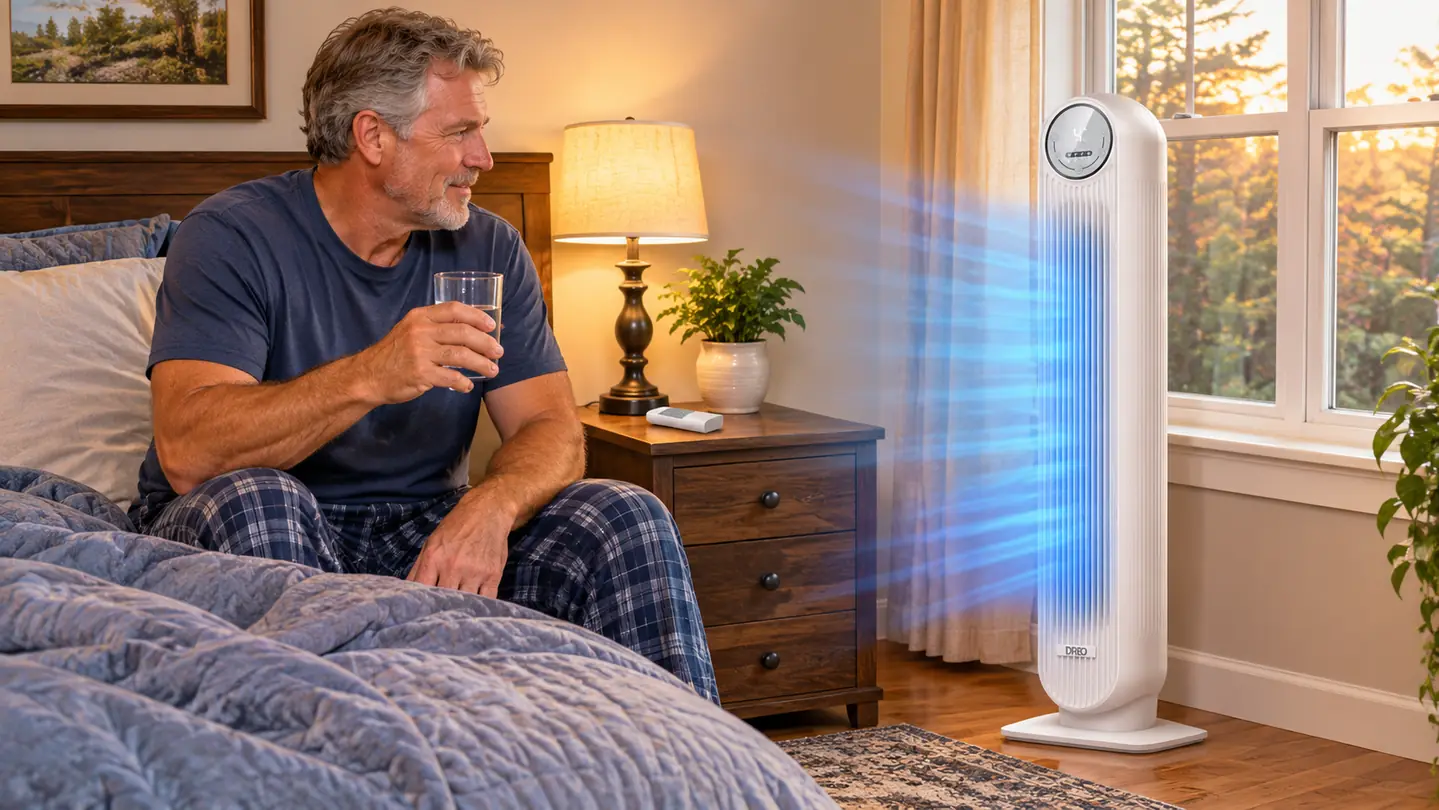
The first thing the tower fan gave me was my arm back. Our ceiling fan runs on a pull chain, and the chain hangs high enough that getting to it means sitting up, leaning across, and hoping I do not knock the lamp off the nightstand. At three in the morning, in the dark, half awake and already overheated, that is three extra chances to wake up properly. The DREO came with a remote, and the remote sits next to the water glass. There is also a touch panel on the fan itself for when the remote goes missing, which it does, because I am the kind of person who loses a remote in a queen bed.
The other thing is the timer. I set it before I get in, usually for about the length of a chapter, and it turns itself off while I am still reading. Then when I wake up hot at two, I turn it back on without opening both eyes. That sounds small. It is not small. The whole trick with night sweats is not getting fully awake in the first place, and every fumble in the dark costs you a half hour.
Then there is the noise, which is the part I did not expect to care about and now care about most. The listing puts this fan at 31 db and I do not own a meter, so I cannot verify that number. What I can tell you is that on the low speeds I have to put a hand out to check it is running, and the ceiling fan on its slowest setting is a sound I can hear from the pillow. There is a brushless DC motor in this one, which the listing credits for the airflow, and the whole unit draws 42 watts. It weighs 3.8 kg, and yes, I carry it downstairs with one hand when the kitchen gets unbearable.
It has eight speeds and four modes, Normal, Natural, Sleep and Auto, and I use about three of them. Sleep mode is the one that matters to me, because it is the mode where the airflow stays gentle enough that I can leave it pointed at my face all night without my eyes drying out. The listing also mentions a feature called Ambient Intelligence. I will be straight with you: I could not tell you what it changes. I turned it on, nothing dramatic happened, and I left it alone. I would rather say that than invent something.
On the low settings I have to put a hand out to check the fan is still running. The ceiling fan is a sound I can hear from the pillow.
Where the Ceiling Fan Wins
The ceiling fan wins the room. That is not a small thing and I am not going to pretend otherwise. Warm air sits up near the ceiling, the fan stirs all of it, and the whole upstairs stops feeling like an attic. When I come in at four in the afternoon with a basket of laundry and the sun has been on that roof all day, the tower fan does nothing for me. It cools the column of air in front of it and that is the end of it. The ceiling fan makes the entire room tolerable in about ninety seconds.
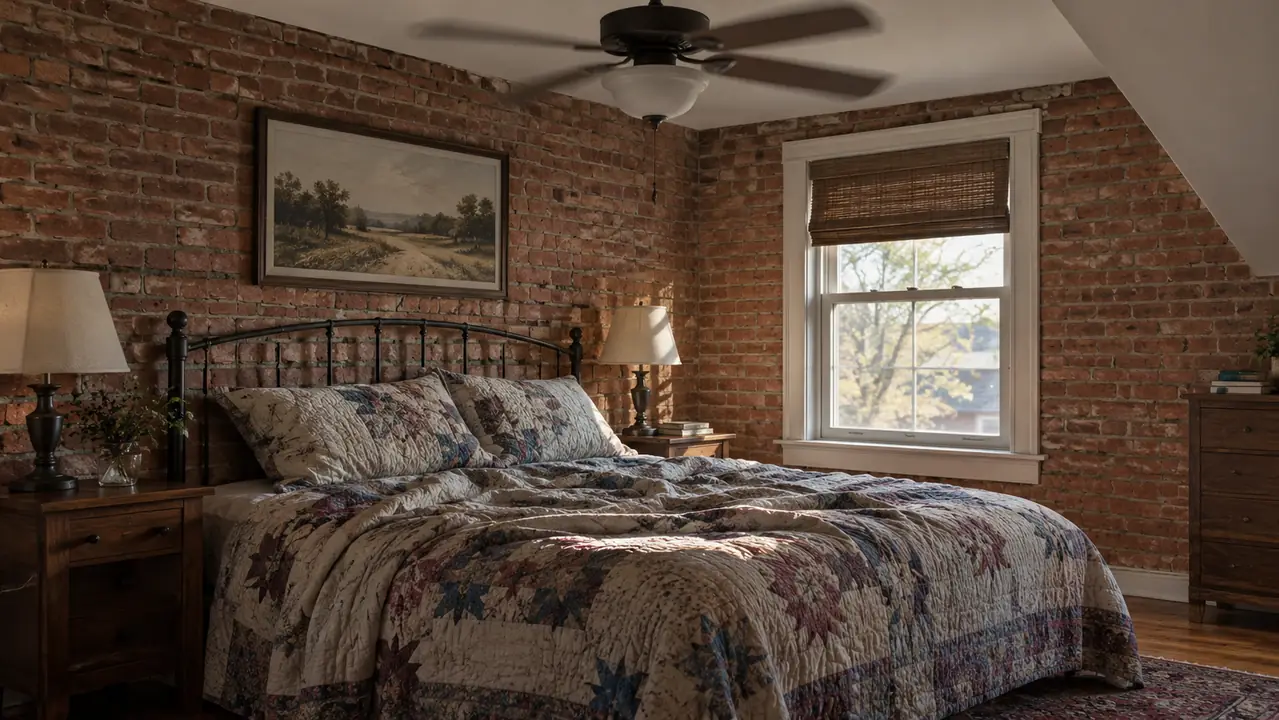
It also takes up no floor space, which matters more in a 1960s brick two story than it sounds. Our bedroom is not large. The tower fan stands between my side of the bed and the window, and it is the first thing my foot finds in the dark. A ceiling fan is out of the way by definition, and there are no cords to trip over at two in the morning.
And it moves air over both of us. I know that sounds like a complaint. Some nights it is. But Rick runs cold, and there are evenings in June when he is under the quilt and I am honestly grateful the ceiling fan is pushing air around the whole room instead of blowing straight at my face, because direct air at the wrong moment is its own kind of miserable. The ceiling fan is also the reason the tower fan does not have to run on its highest speeds, and a fan on low is a fan you forget about.
One more honest note. My ceiling fan was already here when we bought the house. If it had not been, I would be looking at a ladder, a wiring box, and an electrician, and the tower fan would win that comparison without a contest. It arrives in pieces that snap together, a front base and a rear base, and then it plugs into the wall. That is the whole installation.
The fan I reach for at 3 a.m., not 3 p.m.
Eight speeds, four modes including Sleep, remote and touch control, a timer you can set before bed, and 31 db on the low settings. Current price and the full spec sheet are on the listing.
Amazon Check Today's Price on Amazon →How I Actually Compared Them
I did not run a lab. I ran a bedroom. For about ten weeks I alternated: one week with only the ceiling fan, one week with the ceiling fan off and the DREO running, and then both together, which is what I settled on. I kept a pad on the nightstand and wrote down three things each morning: whether I had woken up hot, roughly how long it took to get back to sleep, and whether I had woken Rick in the process. Not exactly science, but it was my own data and it was more useful than any review I read.
Two things came out of that pad. The first is that no fan changed how often I woke up. Not once did a fan prevent a hot flash, and I want to be clear about that because a lot of writing on this subject gets silly. What changed was the second half of the event, the getting back to sleep part. With the ceiling fan alone, I was averaging something like forty minutes awake. With the tower fan on Sleep mode pointed at my side of the bed, that came down to about fifteen. Some of that is probably the fan. Some of it is that I stopped lying there fuming at a pull chain.
The second thing is aim. The DREO oscillates through 90 degrees, which is wide enough to sweep from my pillow to the dresser and back, but the setting I actually use most is the one where it stays put and blows at me. A ceiling fan cannot do that. It moves air in a big circle and if you happen to be under the circle, good for you. That difference is the entire argument, as far as I am concerned. One fan cools a room. The other cools a person.
The Night Sweats Part, Which Is the Whole Reason
I am not going to tell you a fan fixes perimenopause, because it does not. My night sweats started around 51 and they still wake me a few nights a week. A fan does not stop the flash. What it does is shorten the miserable stretch afterward, the part where you are damp, your skin is prickling, and your body has decided it is wide awake at 2:40 in the morning. Cool moving air on the back of my neck gets that stretch down to about fifteen minutes instead of forty. That is the whole benefit and it is enough to matter.
There are practical things I do alongside it. I sleep in a cotton t-shirt instead of anything heavier. I keep a second one folded on the chair so I am not hunting for a dry shirt in the dark. I keep the water glass full. And I have a conversation with my doctor about the flashes themselves, because that part is not a fan problem and I am not qualified to advise anybody on it. If you are where I was two years ago, please have that conversation. Then buy a fan for the twenty minutes after.
Who Should Buy Which
Buy the DREO tower fan if you are the hot one in a bed with a cold one. Buy it if your ceiling fan requires you to sit up and reach for a chain in the dark. Buy it if you want the air aimed at your side of the mattress and nowhere else, if you want a timer so the thing is not running all night, and if you want to be able to move it to the kitchen on a bad afternoon. It is 8 speeds and 4 modes with a proper Sleep setting, and the remote is the reason I stopped waking all the way up. Stick with the ceiling fan if your bedroom is simply too warm in general and you want the whole room stirred, or if you already own one that works and your only complaint is the afternoon stuffiness. Honestly, that is most people. And if you are the one under two blankets, the ceiling fan is probably your fan. The tower fan blows at my side of the bed for a reason. My husband would like it on the record that he did not ask for any of this.
If the ceiling fan cools the room and you still wake up hot, this is the one by my bed
Remote and touch control, a timer, Sleep mode, 8 speeds and 4 modes, 90° oscillation, 31 db on the low settings. Today's price and the full details are on the listing.
Amazon See It on Amazon →