
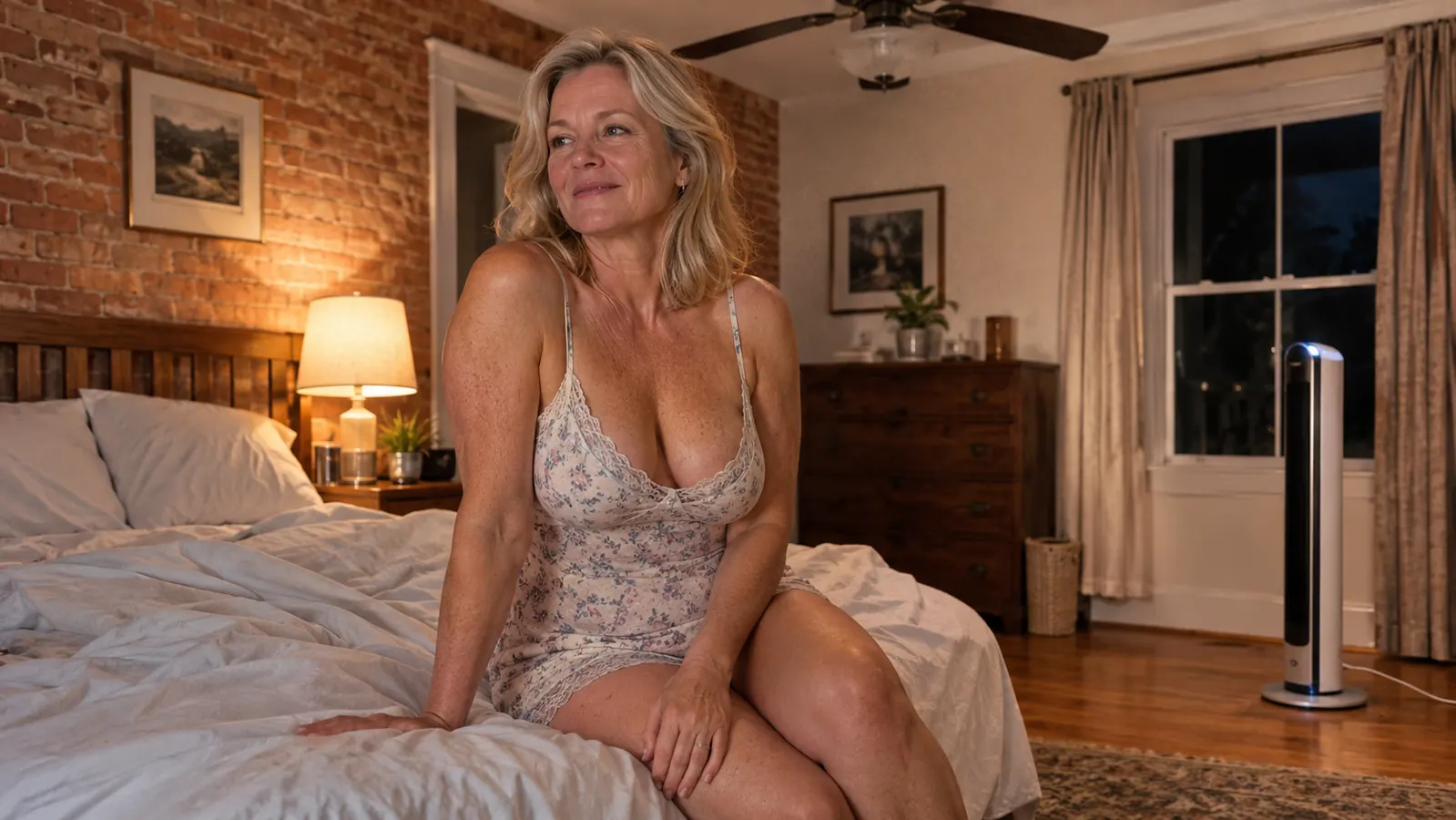
I did not want to like this fan. I want that on the record first, because I have bought three fans in five years and two of them are in the basement, and I am tired of being hopeful about small appliances. I am 54, I spent my working life as a school librarian outside Harrisburg, and since I was about 51 my nights have been broken by sweats that arrive with no warning at all. I wake at 2:40, then at 4:15, then at the alarm. Rick sleeps under a quilt in July. I sleep under a sheet, and only some nights.
The DREO tower fan is the one that finally stayed plugged in. It is a 28 ft/s tower fan with 8 speeds, four modes, a remote, a timer, and a rated noise level of 31 decibels, and it has been running beside my bed nearly every night since it came into the house. What follows is not a launch announcement. It is the review I would give you at my kitchen table, including the parts the product page does not put in bold, and including the two things that still bother me.
The Quick Verdict
The first fan that let me stay in bed instead of standing at the bathroom sink at 3 a.m. Quiet at the low speeds, not silent above them, and it does not cool a room. I kept it anyway.
Amazon Check Today's Price →The One I Stopped Unplugging
Eight speeds, four modes, and a remote that works from the pillow. If your nights look anything like mine, this is where I would start.
Amazon See Today's Price on Amazon →How I've Used It, and Where It Sits
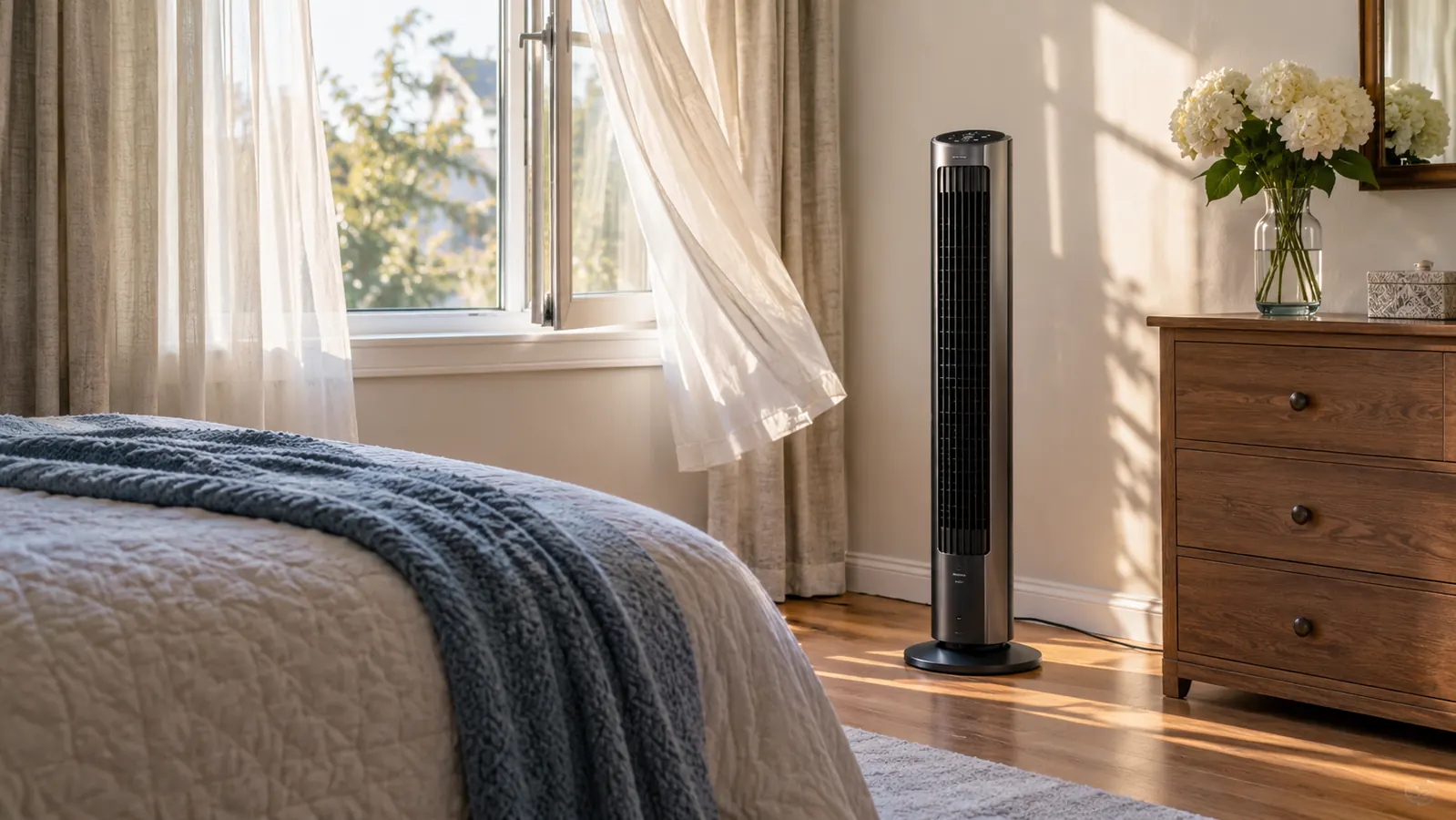
The DREO sits at the corner of the bedroom near the window air conditioner, angled toward my side of the bed. Our bedroom is upstairs in a 1960s brick two story, and the upstairs runs warmer than the downstairs no matter what the thermostat says. The queen bed takes up most of the floor. There is not much room for anything else, which is the first honest point in this fan's favor: a tower fan takes up less floor than the round pedestal fan it replaced, and I can walk past it in the dark without finding it with my shin.
I run it on Sleep mode most nights. Sleep is one of the four modes, alongside Normal, Natural, and Auto, and in my experience it is the one that behaves. I set the speed to 3 of the 8 and leave it there. At 3 I can hear it and I can sleep through it. At 6 I can hear it and I cannot. I have not needed anything above 6 at night, and I doubt most people will.
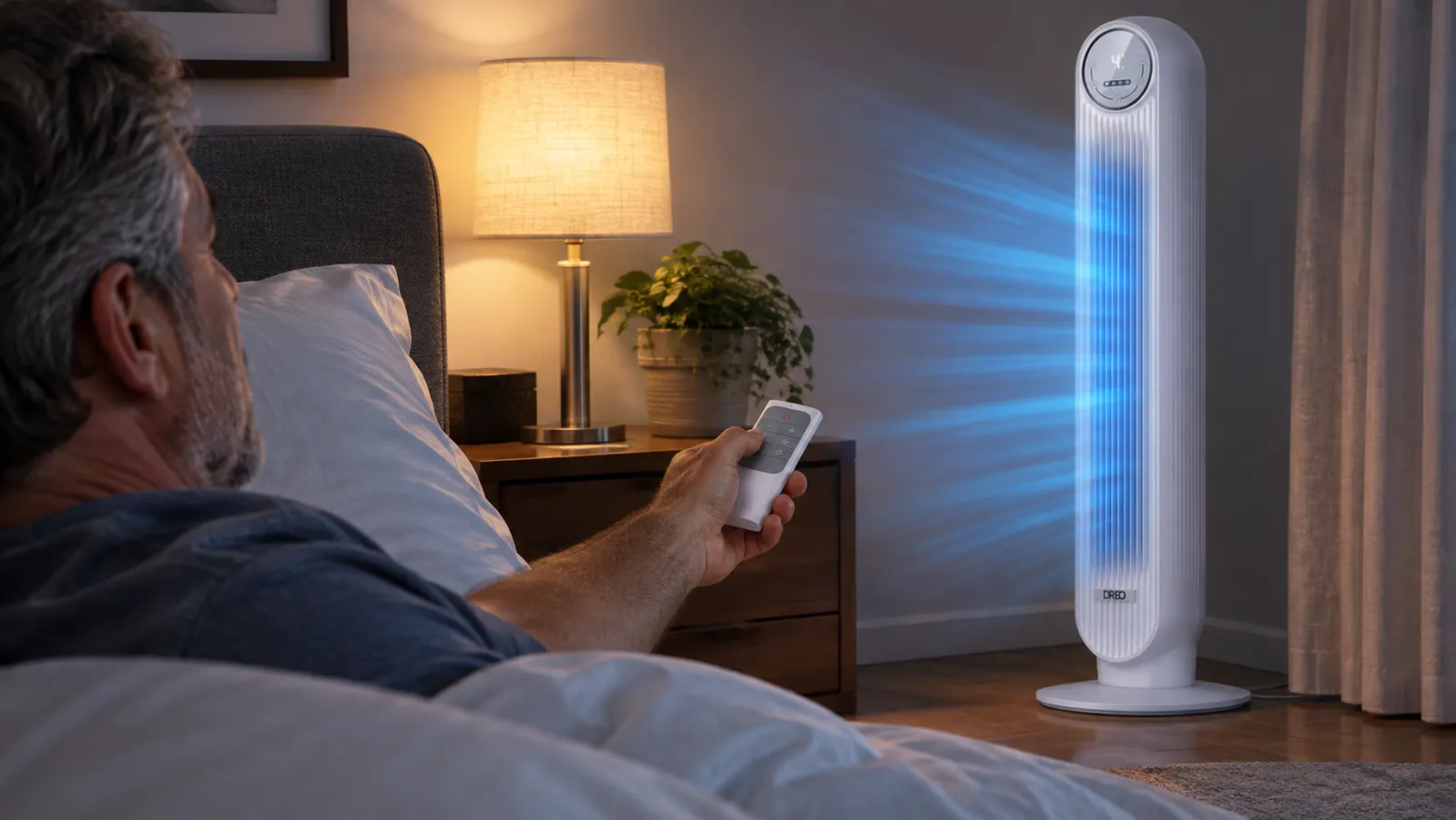
The timer is the feature I did not expect to use and now use every night. I set it for two hours when I get into bed. It runs long enough to carry me past the first sweat, then it stops on its own, and by then the room has settled. When I wake at 2:40, I pick up the remote and start it again without opening my eyes all the way. That is the whole reason this fan stayed. The controls on the fan itself are touch and they work fine, but I am not walking across a dark room at 2:40 in the morning to press them.
One practical note before the good parts. The fan arrived in pieces, with a front base and a rear base that had to be joined before it would stand up. It took me about ten minutes and one reread of the sheet in the box. Budget the ten minutes and do it before bedtime, not at bedtime.
The 31 Decibel Claim, Tested by a Light Sleeper
The listing says 31 decibels. I do not own a decibel meter, so I cannot confirm the number and I am not going to pretend that I can. What I can tell you is what 31 decibels means in a house. My understanding is that it sits somewhere around a quiet bedroom, softer than a refrigerator, louder than nothing at all. That matches speed 1 and speed 2, which are genuinely quiet, quiet enough that I have gotten up to check whether the fan was still running.
Speed 3 is where it stops being invisible. It is a soft, steady hum with a little air sound behind it. For me that is a feature rather than a flaw, because the hum covers Rick's breathing and the neighbor's dog. If you need absolute silence to fall asleep, this is not that fan at any speed above 1, and I would rather tell you now than have you find out at midnight.
The pitch stays low, and that is the detail I would most want someone to tell me. Fans that cost less tend to develop a whine at the top of the range that goes straight through a pillow. At speed 6 this one is loud, but it is a whoosh and not a whine, and I can still sleep next to it. I turn it back down to 3 for the rest of the night and I have never once been woken by the fan itself. Woken by the sweat, yes. By the fan, no.
When I wake at 2:40 I pick up the remote and start it again without opening my eyes all the way. That is the whole reason this fan stayed.
What Nobody Tells You: It Moves Air, It Does Not Cool a Room
A fan does not lower the temperature of a room. It moves air across your skin, which is how your body sheds heat, and that is the whole mechanism. I say this plainly because I spent one August expecting a fan to fix a hot bedroom and being quietly disappointed by every fan I bought. The DREO moves a great deal of air, 28 ft/s at the top of its range by the listing's own number, and it moves that air in a column. Stand in front of it and there is no doubt. Stand three feet to the side and there is considerably less.
The 90 degree oscillation is what makes it usable for a bed instead of a chair. It sweeps across the width of the mattress, so you get the breeze for a few seconds, then a few seconds without it, then it comes back around. That on and off turns out to be exactly what I want during a flash. A constant hard breeze on a damp neck feels cold and clammy inside twenty minutes. The sweep gives my skin a break without giving it a rest.
What it will not do is cool the upstairs. Our bedroom door stays open and the hall stays warm. If your bedroom is above 85 degrees at bedtime, this fan will make it bearable and will not make it cool. Nothing on a stand will do that. That is a window unit conversation, or better, a conversation with your doctor about why your body is running hot at night. I mean that sincerely and I will come back to it.
The Four Modes and the 8 Speeds, and Which Ones I Actually Use
Normal is what it sounds like: you pick a speed and it stays there. That is what my version of Sleep mode amounts to in practice, so I rarely switch it. Natural varies the airflow so it feels less mechanical, a little more like air coming through a screen door, and I know people who love it. It made me feel as though the fan were hesitating, and I stopped using it after a week. Auto mode is meant to handle the adjustments for you, which the listing files under ambient intelligence. I tried that for a week as well. It was fine, and it was not better than choosing my own speed, because I know what my nights look like and the fan does not.
Eight speeds is more than I need and I am glad it is there. The difference between 1 and 2 matters far more than the difference between 7 and 8, because the low end is where you live at night. With 8 steps, speed 2 is gentle enough to leave running and speed 3 is strong enough to matter. On a fan with three speeds you get too little or too much and nothing in between, and you spend the night getting up to adjust it.
The Temperature War With a Husband Who Sleeps Cold
Rick is 57 and he sleeps cold. In July he wants the quilt. I want the window open and a cool cloth on the back of my neck. For years the compromise was that neither of us slept well, which is not a compromise, it is a stalemate with blankets. The ceiling fan made it worse, because a ceiling fan moves air over both of us whether either of us wants it.
What changed with the tower fan is that the air is aimed. It sits on my side of the bed and the sweep stays on my half of the mattress. Rick is under the quilt and reports no change, which is exactly what he wanted. There is a small nightly ritual now: he asks whether the fan is pointed at my side, I say yes, and he goes to sleep. It has done more for our evenings than any conversation we have ever had about the thermostat.
I would tell any couple in this situation the same thing, and it has nothing to do with the brand. Direction matters more than power. A small fan pointed at the person who is hot beats a large fan pointed at the ceiling. That is physics and a marriage, in that order.
Where It Falls Short, Honestly
The airflow is narrow. I said it once and I will say it again, because it is the single thing that kept me from scoring this higher. If you want the whole room stirred, you want a different kind of fan. This one is a column of air that you point at yourself. For a bed that is right. For a living room with four people in it, it is not enough, and you should not buy it expecting otherwise.
The housing is plastic, the base is plastic, and at 3.8 kg it is light enough that I have knocked it slightly out of line with my hip while walking past in the dark. It has not tipped over. It does not feel flimsy, exactly, but it does not feel like something you will hand down to your daughter either. I expect several years out of it. I do not expect fifteen.
And here is the honest one, the one I would want from a friend. This fan helps me sleep through a sweat. It does not stop the sweat. On a bad night I am still up, still at the sink, still waiting for my skin to settle. The fan shortens those nights and it does not end them. If your night sweats are new, severe, or getting worse, that is a doctor conversation and not an appliance conversation. I am a retired librarian with a warm bedroom. I am not a medical professional, and I would rather say so plainly than let a fan review stand in for advice from someone qualified to give it.
What I Liked
- Genuinely quiet at speeds 1 and 2, quiet enough to sleep beside
- The remote works from the pillow, which is the entire point at 2:40 in the morning
- 8 speeds means the low end is actually gentle, not just slightly less loud
- 90 degree oscillation sweeps the bed instead of blasting one spot
- The timer lets it run for two hours and stop on its own
- Takes up less floor than a pedestal fan and is easy to walk past in the dark
Where It Falls Short
- Airflow is a narrow column, so it cools the person and not the room
- Audible at speed 3 and above, so it is not a silent fan
- Plastic housing at 3.8 kg, and it slides out of line if you bump it
- Natural mode felt hesitant to me and I stopped using it
- Front and rear base pieces have to be joined before first use
Who This Is For
This is for the woman who wakes at 2 a.m. hot and does not want to get out of bed to deal with it. If your bedroom is upstairs and warm, if your husband is under a quilt while you are under a sheet, if you have tried a box fan and found it too loud and a ceiling fan and found it too far away, this fan is aimed directly at your problem. It is also for anyone who wants air pointed at one person rather than the whole room, which is what a shared bed in a temperature war actually requires.
It suits a bedside or a corner near the bed, a room where you can leave it in one place and forget about it. It suits someone who will actually use a remote. If you are the sort who loses remotes, the touch controls on the fan itself are there and they work, so you will not be stuck.
Who Should Skip It
Skip it if you want to cool a whole room. That is not what a tower fan does and this one does not do it either. Skip it if you need silence, because at any speed above 1 there is a hum, even if it is a pleasant one. Skip it if you want a fan you can point at the ceiling and forget, because the value here is in the aim, the sweep, and the remote, and you would be paying for three things you will not use.
And skip it if what you actually need is a conversation with your doctor. A fan is a comfort measure. This one got me from four bad nights a week to two. Two is better than four. Two is not zero.
Two Bad Nights Instead of Four
That is what this fan bought me, and I will take it. If your bedroom runs warm and your nights run broken, it is worth a look.
Amazon See Today's Price on Amazon →