

I have slept in the same upstairs bedroom for twenty-six years, and for the last three I have been the woman standing at the window at two in the morning with her nightgown stuck to her back, waiting for a breeze that never comes. The house is a 1960s brick two-story outside Harrisburg. Heat rises. Every July and August the upstairs runs four or five degrees warmer than the kitchen, and my own thermostat adds another ten on top of that. Rick sleeps under a quilt with the covers pulled to his chin while I lie two feet away in damp cotton, so turning the whole room into a cold box is not something I can do to him.
The DREO tower fan by my side of the bed is the one thing in that room I can aim at myself and nobody else. It sits on the floor between the nightstand and the wall, and on a bad night I run it at speed two with the oscillation off, pointed straight at my shoulders. What follows is how I set mine up, in the order I would tell a friend over coffee, including the parts that took me two summers to get right.
Point the Air at You, Not at the Whole Room
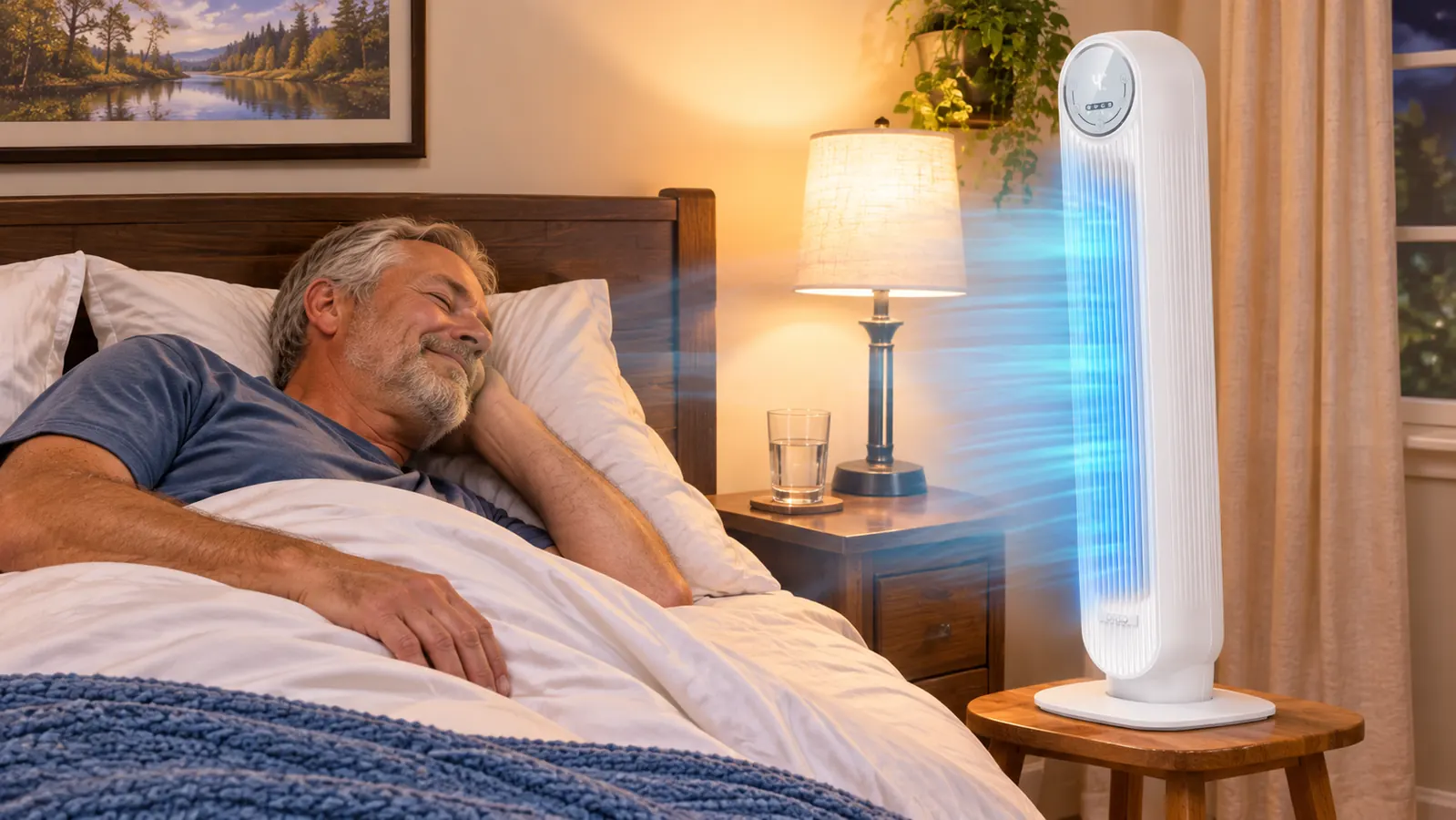
The DREO tower fan moves up to 28 feet per second at its top speed and settles down to 31 decibels in Sleep Mode, which is quiet enough that Rick has never once asked me to turn it down.
Amazon Check Today's Price on Amazon →Why the Upstairs Room Fights You
Warm air rises, and a 1960s brick house hangs onto it. By evening the second floor has been baking under the roof all day, and the bedroom walls are still throwing heat back at you at ten o'clock. The window unit in our room cools the air, but cold air pools low and the bed sits above it. The result is a room that reads sixty-eight on a thermometer and still feels stuffy at the pillow.
A tower fan does not lower the temperature. Nothing in this article lowers the temperature except the air conditioner and closing the curtains earlier in the day. What the fan does is move air across your skin, which is how your body actually sheds heat. That distinction is the whole game. Once I stopped expecting the fan to cool the room and started expecting it to cool me, the setup got a great deal simpler.
Step 1: Find the Hot Spot Before You Move Anything
Before I moved a single piece of furniture, I put a cheap thermometer on the nightstand and another on the dresser by the window and checked them at seven in the evening and again at eleven. The nightstand ran two degrees warmer. The corner by the closet door was worse, because the door stayed shut and the air in that corner never moved at all.
Do the same for a week and write it down. Note the time your face starts to feel hot. For me it lands about ninety minutes after I get into bed, which tells me the problem is not the room at eight o'clock. The problem is the bed at ten.
Check the obvious things before you blame the air. Is the ceiling fan pulling air up instead of pushing it down? Are the curtains open all afternoon letting the sun bake the carpet? Is the bedroom door shut with no return path for air? I found three fixes in this step alone and none of them cost me a nickel.
Step 2: Aim the Air at the Bed, Not the Ceiling
My first mistake was pointing the fan at the middle of the room and letting it swing back and forth. That looks pleasant and does almost nothing, because the air has to be moving where your skin is, not where the floor is. Now the fan sits about six feet from my side of the bed, angled up toward the pillow.
The DREO pushes up to 28 feet per second at its highest setting, which is far more than I want on my face. Speed two or three is plenty at six feet. The 90 degree oscillation is worth using in the hour before bed, when I want the whole sleeping area to stop feeling stale. Once I am actually under the covers, I turn the oscillation off and leave it pointed at my shoulders and the back of my neck, which is where my heat seems to start.
The other thing I got wrong for a long time was height. A tower fan sitting flat on the floor delivers its air to the side of the mattress, which is exactly where you do not need it. Mine now sits on a low wooden stool so the top of the airflow lands at pillow height. That single change did more for me than any setting on the unit.
Step 3: Set Sleep Mode Before You Get In
The DREO has eight speeds and four modes: Normal, Natural, Sleep and Auto. I use Sleep, and I set it before I get into bed rather than at two in the morning when I am half awake and fumbling in the dark. Sleep mode keeps the airflow gentle and the unit quiet, and the listing puts it at 31 decibels, which in our room is quieter than the window unit cycling on.
There is a timer, and I use it more than I expected to. I set it for four hours. If I wake at two and I am hot, the remote is already on the nightstand and I can bump the speed without standing up. If I am not hot, the fan stops on its own instead of blowing on me until dawn and leaving my neck stiff. The touch panel on top is there too, but I have not touched it since the first week.
Auto mode is the one I would try on a mild night, not on a bad one. The fan adjusts its own speed as conditions shift, which is useful, but on a night when I am already overheating I want to be the one deciding how much air I get. Keep Normal for the sticky nights and let Auto handle the ones where the weather cannot make up its mind.
Speed two at six feet, aimed at the pillow, does more for me than speed eight aimed at the middle of the room ever did.
Step 4: Fix the Bed Itself, Not Just the Air
A fan blowing across a polyester comforter is wasted effort, because the bedding holds the heat in. We now keep two sets of bedding on the same queen bed, which sounds ridiculous and has saved us a good deal of grief. Rick has his quilt. I have a cotton blanket light enough to fold back at two in the morning without waking him, over a cotton fitted sheet.
The mattress pad mattered more than I expected. I swapped a quilted synthetic pad for a thin cotton one and the bed stopped feeling like a warm brick under my back. If you are not ready to replace anything, start with the pillowcase. Cotton or linen, changed every other day in July. A cool pillowcase against a hot cheek at three in the morning does more than you would think.
One more thing I do, and it is not elegant. I keep a small bowl of cool water and a washcloth on the nightstand. When I wake up sweating, I wipe my face, my neck and the inside of my wrists and lie back down. It buys me twenty minutes, and twenty minutes is sometimes the whole difference between a bad night and a survivable one.
Step 5: Pre-Cool the Room and Close the Door
The upstairs bedroom needs to be cooled before I get into it, not after. At about eight o'clock I close the bedroom door, run the window unit on high for forty minutes, and let the DREO run on Natural to push that cold air around the room instead of letting it sit in one corner. Then I turn the window unit down and shut it off at bedtime. The room holds the cool for a couple of hours, which is exactly the window where I used to wake up drenched.
During the day the door stays shut and the curtains stay drawn on the west side. That one habit dropped the evening temperature in our room noticeably. The ceiling fan runs on low through the afternoon to keep the air from separating into layers, and I switch the DREO on when I come upstairs to get ready for bed, so the air is already moving before I climb in.
If you take nothing else from this, take the timing. Cooling a room while you are already lying in it and sweating is the slowest possible way to do it.
What the Fan Will Not Do
It will not lower the temperature in the room. It will not dry out a humid Pennsylvania August night the way an air conditioner does, and it will not stop a hot flash. I want to be plain about that, because I spent money on two other fans expecting otherwise.
It also will not help much if the air it is moving is ninety degrees and stagnant. In that case you need the window unit or a dehumidifier first and the fan second, to spread the result around. And if your night sweats have gotten heavier, or you are waking up soaked several nights a week, that is a conversation for your doctor rather than a shopping decision. I am a retired school librarian, not a physician, and there is a real difference between a bedroom problem and a medical one.
What Else Helps
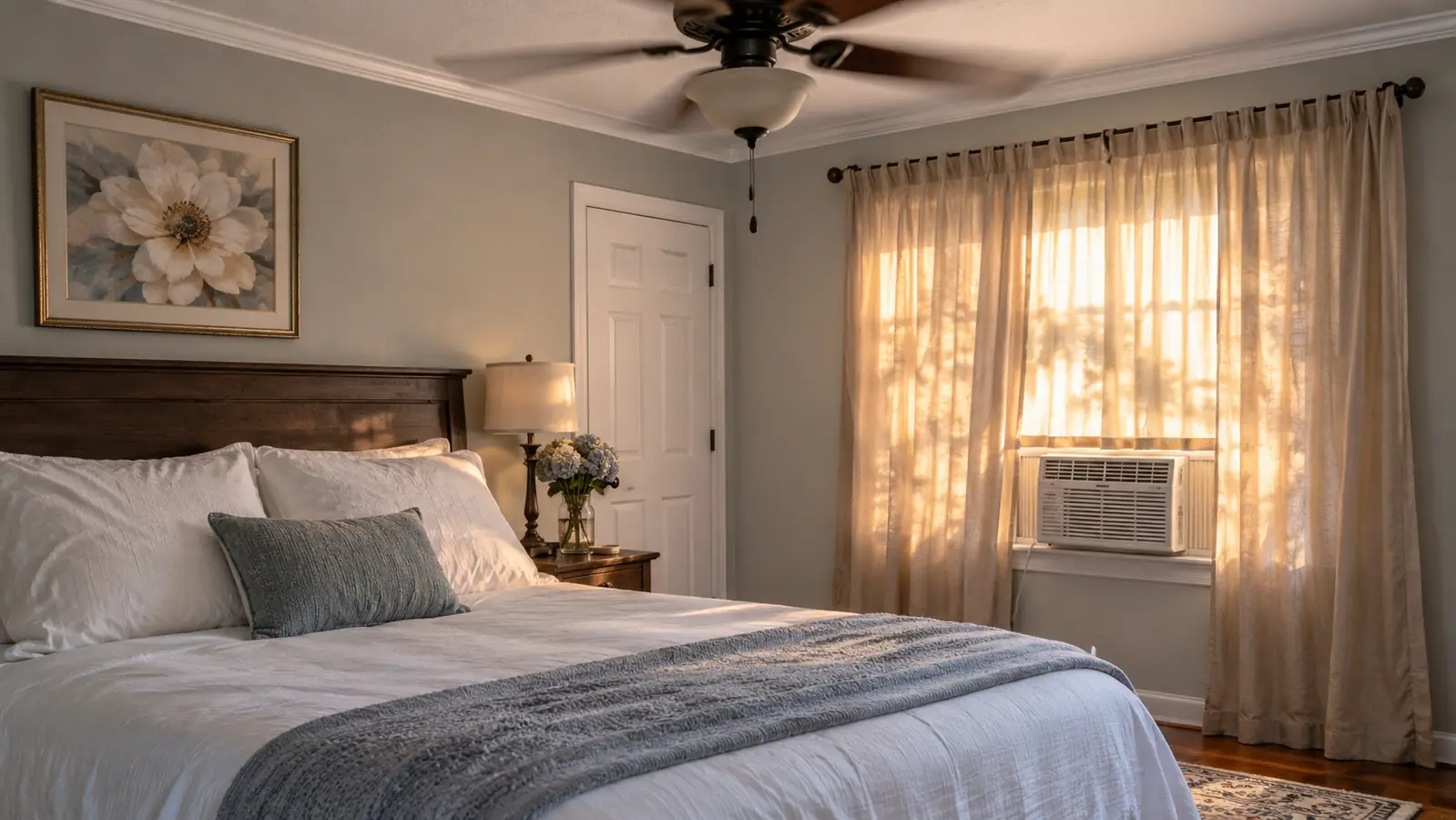
The window air conditioner does the heavy lifting and the DREO makes it usable. If you have central air, close the upstairs vents during the day and open them an hour before bed. Blackout curtains on the sun side of the house are worth the money. A dehumidifier in the hallway pulled a surprising amount of moisture out of our upstairs and made sixty-eight degrees feel like sixty-eight instead of seventy-four.
The ceiling fan still earns its place. I run it on low and keep the pull chain set for summer so it pushes air down rather than pulling it up. Between the ceiling fan moving the upper air and the tower fan moving the air at the bed, the room feels like a different room than it did two summers ago.
And keep the fan clean. The DREO is easy to wipe down, but the front grille collects dust faster than you would guess in a bedroom. I run a vacuum brush over it every couple of weeks in summer. A dusty fan moves less air and makes more noise, and neither of those helps anyone at two in the morning.
Start With the Air at the Pillow
Eight speeds, four modes, a remote on the nightstand and a timer that shuts it off before dawn. That is the setup that got me through last August, and I would set it up the same way again.
Amazon Check Today's Price on Amazon →